

What If the Immigration Crackdown Is the Wrong Question for the Haitian Community?
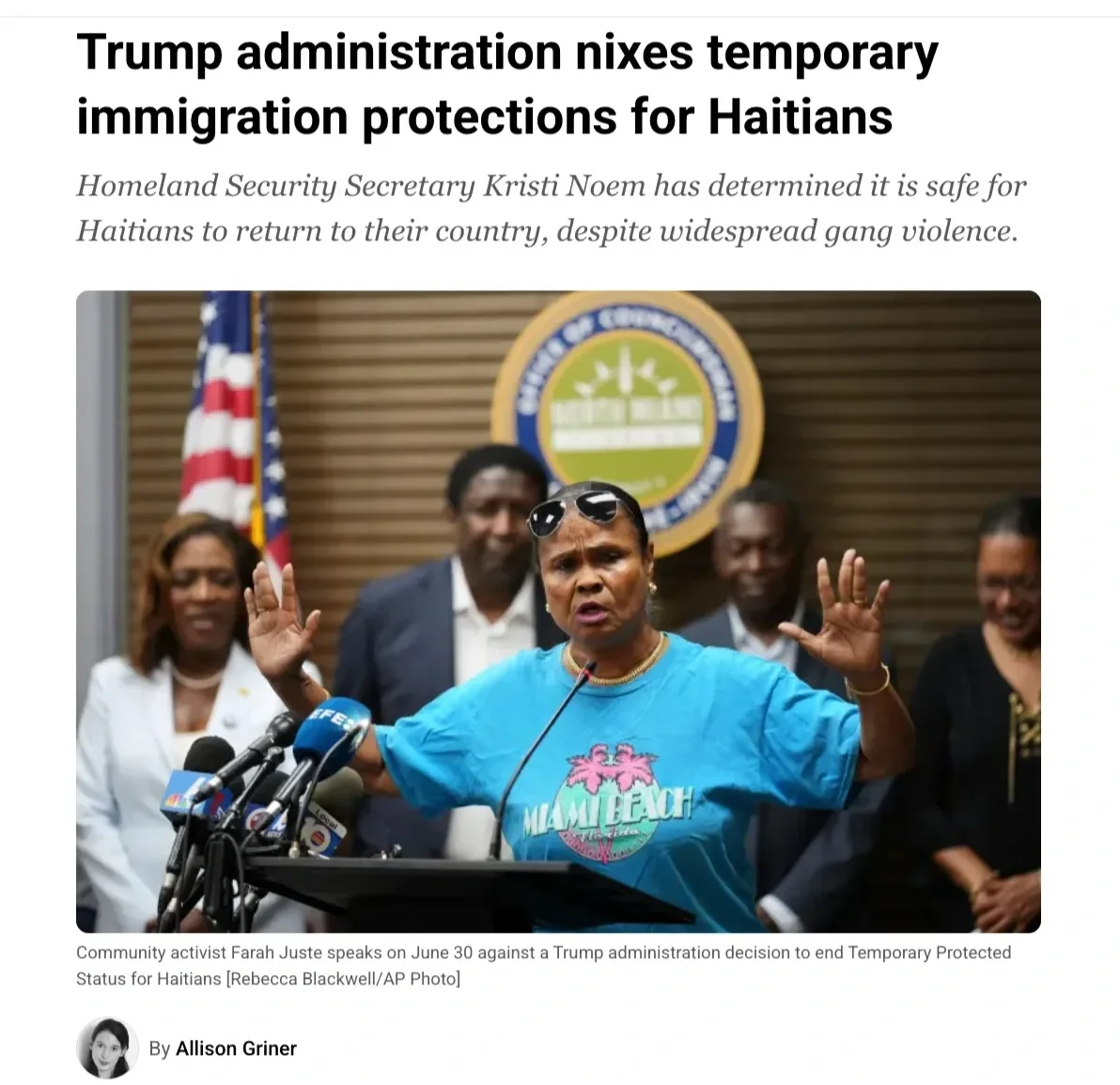
As 2025 comes to a close, the Trump administration’s campaign against immigrants has reached a point where its cruelty is but a steady and pervasive condition of our lives. What began with claims about removing the “worst of the worst” has widened to include all immigrants, including those who entered legally, permanent residents who built lives here over decades, and even naturalized citizens who now understand that legal papers alone do not shield anyone from suspicion.
None of this comes as a surprise. The administration did not merely hint at its intentions; it laid them out openly for all to see. The “Making America Great Again” project has always depended on a narrow vision of who belongs in America, and the courts, alongside a pliant Congress, have supplied the mechanisms to enforce that vision step by predictable step.
In light of this reality, it is hard to watch Haitian leaders continue to lobby and make pilgrimages to Washington, appealing for mercy from American officials who have repeatedly expressed open disdain for our country and for people who look like us.
Over the past year, the President’s rhetoric has hardened into action.
The administration has systematically dismantled the core pillars of the immigration system, bulldozed the legal due processes, and tracked people down in wildly publicized spectacles that are used to terrify immigrant families. The cruelty here is not an unintended consequence; it is the method.
The pain inflicted on immigrant families, including Haitians, is profound. People who worked, paid taxes, and followed the rules now face unemployment, detention, or forced return to a country where gangs exert control over daily life.
The psychological strain of living under constant threat is immense and exhausting.
While our outrage at our sustained dehumanization is justified, it cannot be the endpoint. Instead, it must push us toward a more difficult reckoning with what’s coming. If large numbers of Haitians are being forced back by deportation or leaving out of fear, then the question is the following: What are we doing to ensure that Haiti itself is capable of protecting its own people?
The Returns Have Already Begun
The revocation of Temporary Protected Status and related protections places more than half a million Haitians in the United States at risk. At the same time, the Dominican Republic has deported 276,215 Haitians this year, while official figures indicate that more than 115,000 others left on their own as legal, economic, and social pressures have mounted, making their lives impossible. These are two different countries at work, but their policies produce the same result. Still, Haitians who have emigrated to other countries in the region are having similar experiences. As a result, they too will go back to Haiti, a country under siege.
Armed gangs now exercise near-total control over large swaths of territory, effectively splitting the country by seizing critical national roads and terrorizing communities with impunity.
According to the United Nations Human Rights Office (UNHRO), 5,601 people were killed in Haiti in 2024 alone, with thousands more kidnapped, raped, or permanently displaced. And they only account for those who were officially recorded. To put this context, despite having no foreign army occupying its territory, in one year, Haiti has suffered nearly half the civilian death toll recorded in Ukraine after three years of full-scale invasion by Russia.
Haiti is not at war with another nation but is being destroyed from within. Although external interests likely benefit from this collapse, the hands pulling the triggers are Haitian. As the proverb reminds us, si anndan pa vann, deyò pa ka achte.
As hundreds of thousands of people are forced to return under these conditions, the shock will reverberate across the few fragile systems that remain. The sudden loss of remittances will accelerate the collapse of an economy already in contraction, while the influx of returnees into rural areas will further strain communities and deepen national insecurity as families bypass the violence of Port-au-Prince. While activists in the United States continue the necessary fight against brutal immigration policies, we must ask a more fundamental question. What will it take to make Haiti safe, both for those forced to return and for those of us who long to return by choice to a country where Blackness is not a crime?
Haitian Agency Is Not Denial of Foreign Harm
I am a firm proponent of Haitian agency, a position that some might mischaracterize as minimizing the damage inflicted by the international community. But it is precisely because that damage has been so serious, persistent, and destructive that we must stop outsourcing responsibility for our survival. Continuing to rely on “friends” who have repeatedly failed us is not merely a strategic error but a form of complicity. It affirms our refusal to shoulder the heavy burdens that survival now demands. In the final analysis, the tragedy is not their betrayal of Haiti, but our own.
No foreign power can rescue Haiti. Not the Kenyans, not the OAS, not the Chinese, the Russians, or the Core Group. There is no rational basis for expecting other nations to fix our country, and this truth must be the starting point for any national reckoning.
In conversations, I often hear the same questions asked with sincerity and real pain: Why does the United States keep sending weapons to Haiti? What does America want from us? These questions are understandable. They are rooted in a long history of betrayal and exploitation, yet beneath them lies a familiar reflex to externalize blame and defer responsibility. Se pa fòt mwen remains a national refrain. If there was any doubt about U.S. intentions toward Haiti, the Trump administration has put it to rest by leaving no ambiguity about its motives. When U.S. interests are at stake, action follows, and Haiti’s absence from that calculus speaks volumes.
Indeed, if Haiti truly possessed the vast oil reserves or rare minerals that many of our fellow Haitians believe it does, this administration would have already moved to claim them. On that point, there is little doubt.
Moreover, these questions reveal a deep paradox among Haitians. We denounce the United States as the primary source of Haiti’s suffering, yet we simultaneously wait for Washington to act through the United Nations or the OAS to lead a force capable of suppressing Haitian gangs.
We condemn American power even as we appeal to it for salvation.
To be sure, any alignment between U.S. and Haitian interests is the product of circumstance, not solidarity. The most recent National Security Strategy makes clear that armed gangs are viewed primarily through the lens of regional stability, migration control, and national security concerns. Within that framework, Haiti is not treated as a country to be rebuilt, but as a problem to be contained. Any intervention that follows from this logic will be blunt, interest-driven, and temporary, aimed at reducing risk rather than transforming conditions.
The likely outcomes are limited. Gangs may retreat under pressure only to regroup once foreign forces withdraw, or we face a deeper, longer occupation with all the political consequences that implies. Neither leads to sovereignty.
True agency requires confronting uncomfortable truths about ourselves. Much of Haiti’s violence is enabled by Haitians who participate directly in weapons trafficking, human trafficking, drug smuggling, and money laundering. We often repeat that Haiti does not manufacture guns as if that absolves us, but while weapons are produced abroad, international reporting confirms that Haitian elites organize their importation. A GAO report found that 73% of firearms recovered in the Caribbean can be traced to the United States, yet the trafficking networks that move those weapons into Haiti are run by Haitians. If we are serious about security, our focus must shift from the distant suppliers to the domestic enablers.
Self-reliance is not a slogan but the only consistent response to harmful foreign involvement. When we ask the international community to solve our crises, it responds according to its interests, not ours. Whatever the origins of Haiti’s wounds, the responsibility for healing the country today rests with us.
Elite Failure and Popular Resistance
Haiti’s political and economic elites have failed as a class. They have been unable to find a common cause, mobilize our national resources, however limited, or prioritize public security. That failure is measured in body counts, displacement, and pervasive fear. Yet the country’s unraveling has not been met with total resignation from the population.
In Canape-Vert, residents self-organized and refused to surrender their neighborhood. In April 2023, police arrested gang members en route to reinforce another group. The residents of Canapé-Vert later seized and killed them, igniting what became the broader Bwa Kale movement. In the Nippes department, gangs repeatedly announced their intention to take control of the area and repeatedly failed. In most cases, they do carry out their threats, but here that pattern was broken, showing that a different outcome is possible. This shows that when Haitians organize with purpose, we can defend ourselves.
What is missing is not courage or capacity, but leadership capable of disciplining, coordinating, and channeling this energy through the legitimate institutions rather than allowing it to erupt in moments of desperation.
We must be under no illusions regarding the limitations of external support. Foreign forces on the ground, including the Kenya-led mission, are not there to save Haiti but merely to assist the Haitian National Police. Without domestic organization, political will, and sustained national financing, such efforts risk becoming another footnote in a long history of short-lived interventions that failed to alter underlying conditions. Moreover, security cannot be reduced to raids or troop deployments; it requires political leadership, institutional reform, economic disruption of gangs, community engagement, and sustained investment in policing and justice. None of this work can be outsourced, for it requires Haitian ownership if resistance is to become stability rather than a recurring cycle of crisis.
The Responsibility of Ayisyen Andeyò
This brings us to the Ayisyen Andeyò, a term that encompasses not only those living in Haiti’s rural provinces but also the millions of us living outside the country. If sovereignty is the goal, financing our own security must become a national responsibility rather than an act of charity by others and left to their whim. This is a matter of self-preservation because, although some of us live far from gang-controlled zones, the insecurity radiates outward to destabilize the entire country and touches all of us.
Our obligation begins with an uncomfortable reality: too much of Haiti’s security infrastructure remains externally financed. The U.S. State Department has poured hundreds of millions of dollars into training and equipping the Haitian National Police, yet a 2023 Government Accountability Office report described the results as “mixed,” noting that evaluations focused more on outputs than on actual improvements in capacity. Furthermore, the Biden Administration allocated over $237 million in bilateral assistance for Haiti in FY2022 alone. A state that cannot fund its own core functions cannot credibly claim sovereignty. We are a proud people, but let’s be clear, dependence comes with conditions, and when we rely on others to protect us, we allow them to shape our priorities, timelines, and outcomes. And this is not happening because of 1804, despite the broad anti-Blackness sweeping many Western countries.
If we ever held any illusion of Haitian exceptionalism, the Trump administration has shattered it.
We see the same logic at work in Europe, where governments that relied for decades on American security guarantees are now being openly pressured to assume responsibility for their own defense. The administration’s demand that NATO members drastically increase their spending sends an unmistakable message: protection follows interest, not obligation. By the way, this is a good thing.
Given our history of U.S. occupation and continued interference, we cannot denounce foreign intervention as domination while quietly outsourcing the most basic duties of the state to them. We still live with the consequences of the 1934 withdrawal, where the U.S. left behind a centralized government that limited political participation, but we can no longer use history as an excuse to refuse the burdens of self-determination. As I have written before, Haiti possesses the resources to change course. With remittances totaling nearly $3.9 billion in 2024, roughly 15.5 percent of the country's GDP, Haitians abroad already sustain families and prevent community collapse. The question is not whether we have resources but whether we have the will to redirect them toward our collective security. A trusted government could have long ago created the mechanisms needed to supplement local taxes with financing from Haitians abroad.
Agency, at this stage, is not about aspiration. It is about commitment, discipline, and shared sacrifice.
A Wish for 2026
My wish for 2026 is that we stop confusing anger with strategy. Anger must serve as fuel for sustained construction, not evaporate into empty rhetoric or paralyzing resignation.
Reclaiming our sovereignty requires more than denouncing the international community. It demands the discipline to finance our own security, organize politically, and force our elites to serve the national interest. This responsibility cannot remain a talking point. Instead, it must be institutional, financial, and collective.
The Trump administration’s “America First” doctrine forces us to confront a truth we have long evaded. Haiti’s sovereignty was not a favor bestowed, nor is it something that can be negotiated. It was seized through sacrifice and must be actively defended as a legacy we are obligated to preserve and pass on. We must uphold it even when doing so is costly, uncomfortable, and lonely. In a world that has made clear it will not save us, this remains the only choice left.