

Moun Andeyò, Part II
A National Compact for a New Haitian Future
I will begin with an admission I have made before. I am tired of conversations where our starting point and ending point are the international community. As I wrote in Pont Sondé Again: Facing the Enemy Within, the issue is not that foreign interference is imaginary. It is real and harmful. It is also predictable. What is damaging us more profoundly are the choices we make in response.
We have spent years treating foreign actors as the center of our crisis instead of confronting the painful fact that Haitians have weakened Haiti as much as anyone else.
In my piece Pont Sondé Massacre: A Defining Moment for Haiti’s Survival, I wrote that what broke me was not only the brutality of that killing field but the fact that Haitians were killing Haitians. That was true then and remains true today. We have created a political culture that rewards self-preservation, economic capture, and moral indifference. We have normalized the betrayal of ourselves. We have accepted a politics of exclusion of the majority of Haitians. We have spent more energy reacting to foreign diplomats than organizing our own people.
“Haiti is a small country in the shadows of a superpower in a unipolar world. Whether we like it or not, the United States will play a role in resolving the crisis.” But we cannot allow our reaction to that fact to blind us to the real enemy within. Our future depends on learning from our own history. We can either learn to negotiate like the Dominican Republic when necessary or stand firm like Burkina Faso. What we cannot do is continue believing that our liberation will be handed to us.
The truth is simple. Haiti already has what it needs to change course.
We have intelligence, resources, global presence, and a resilient culture that refuses to die. When we choose discipline and unity, we can move mountains. Our problem has never been incapacity. It has been our refusal to trust our own power and accept that grès kochon an ka kwit kochon an.
Yet we keep looking outward. We bend to every comment from a foreign embassy. We wait for donors to tell us when we are allowed to care about our own security. We give away authority in exchange for recognition. This mindset has weakened us more than any embargo, sanction, or diplomatic pressure. This is not on them – it is on us!
For years, I have argued that we could fund our own security. We have the economic power to equip the police, reinforce border control, and invest in intelligence. We have the resources, but we wait for permission to use them, or worse, we waste or plunder the state’s coffers. Every time we wait for a donor, we don’t lose our sovereignty; we willfully surrender it for pennies on the dollar.
Haiti needs proud citizens who value competence, beauty, discipline, and dignity. Nou bezwen vin pi frekan nan jan nou bay konpetans valè e nan jan nou renmen sa ki bèl ak sa ki byen fèt. A new Haiti must grow from a cultural shift that honors responsibility and rejects the culture of excuses.
A Week That Revealed What is at Stake
Early December reminded us that Haiti’s crisis is held in place by decisions made by Haitians. On December 2, the Gran Grif gang launched new attacks in Pont Sondé. Reporting from the Haitian Times confirmed houses burned, families fleeing, and communities terrorized once again in their article Gang attack in Haiti’s Pont-Sondé leaves 12 dead, homes burned. The same region that endured the massacre I wrote about a year earlier is still under assault. The same cycle and tragedy. The same refusal by the state to defend its citizens.
Two days later, the Transitional Presidential Council adopted an electoral decree that continues the exclusion of the majority. I analyzed this in What to the Haitians Andeyò Is the Latest Electoral Decree? and the Haitian Times provided further reporting in Haiti elections: Electoral decree raises new concerns amid security crisis. The decree keeps property ownership requirements that most citizens cannot meet. It requires in-person voter registration only inside Haiti, which blocks participation by Haitians andeyò. It keeps residency rules designed to lock out anyone who is living outside the large urban centers or the country. This was not inclusion. It was exclusion dressed as democracy.
Instead of widening the political space, the Transitional Electoral Council (CEP) protected the same narrow circle that has held power for decades.
We can point to the OAS or the US. However, my reading is that this was a deliberate choice and another example of Haitians weakening their own people to protect personal gain.
These two events are connected. Political exclusion feeds insecurity. When the majority is denied a voice, the country becomes easier to destabilize. When politics remains the private property of the few, violence becomes a tool to preserve their advantage.
This is why we must build a movement.
We Need a Movement with Three Pillars
Haiti needs a movement that gives shape to our anger, direction to our dignity, and purpose to our sacrifices. That movement is the moun andeyò movement, and it rests on three pillars that allow a society to breathe and grow: security, prosperity, and education. These form the foundation of the Campaign for Dignity.
1. Security: Reclaiming the Right to Live Without Fear
Security is the first responsibility of a state. Without it, no society can stand. Haiti’s insecurity is not only the work of gangs. It is the product of a political and economic system that treats violence as a tool of influence. Criminal groups do not grow in isolation. They grow because actors inside the state and private sector protect them.
The latest attacks on Pont Sondé make this painfully clear. Gangs have pushed deeper into the Lower Artibonite and seized ODVA infrastructure that regulates water for the rice fields. The Artibonite Valley produces most of Haiti’s domestic rice. To strike this system is to strike at food security, rural livelihoods, and national survival.
Many Haitians believe these attacks are not random. They argue that powerful rice importers who profit from foreign dependence benefit when domestic production collapses. Whether fully proven or not, the pattern is real. Irrigation canals, water stations, and farming communities keep falling under fire. Someone profits each time the Artibonite is weakened. And if the theory holds, communities in the north, where Kanal la Pap Kanpe is reviving rice production, must prepare to defend themselves because the gangs will come.
In the debate about Haiti’s crisis, three truths stand out.
First, Haitians are sending and buying the weapons that fuel this conflict.
Second, Haitian gangs are killing Haitian citizens, often with political, economic, or state actors in the background.
Third, only Haitians can save Haiti. No foreign country will place our survival above its own interests. We can criticize Kenya, but Kenyans will not die for Haitian freedom.
The enemy within is not only the gangs. It is the politicians who negotiate with them. It is the businessmen who finance them. It is the officers who look away or actively collaborate with them.
It is the state that refuses to invest in security while benefiting from disorder. These are not American or French decisions. They are Haitian decisions.
Haiti is at war. A country at war must act like it. Not through vengeance, but through organization, unity, and seriousness. Yet we hear every day that the police and the army need resources. This is an issue that continues to drive me crazy because we have the means to change it. What we lack is collective will and disciplined action.
2. Prosperity: Ending the Monopoly and Building a Real Economy
Haiti cannot prosper while Port-au-Prince concentrates nearly all political and economic power. The country cannot grow when opportunity and public investments are captured by one department and a handful of people in Pétion-Ville. Real development requires decentralization, regional investment, and the courage to confront monopolies that suffocate production.
Prosperity begins with empowering small producers, expanding access to credit, strengthening agriculture, and investing in infrastructure in the provinces. It requires building regional economic hubs in Cap-Haïtien, Les Cayes, Gonaïves, and Jacmel that can sustain jobs, attract capital, and reduce pressure on the capital. It also demands challenging the import-driven system that enriches a few and impoverishes the many. And those of us, Haitians andeyò, have a role to play. It is counterintuitive to pay more when needs are high, but if we want food independence, we must buy and consume what is produced at home.
Consider the Artibonite again. When gangs seize irrigation infrastructure, they do more than displace farmers. They destroy the foundation of a regional economy. Rebuilding prosperity means protecting these systems and giving Haitian producers a chance to compete. It means breaking the stranglehold of importers who have every incentive to keep agriculture weak.
The moun andeyò are the backbone of Haiti’s real economy. They send the money that keeps families afloat. They grow food, build homes, and move goods. Once organized, they will become the engine of national growth.
3. Education: Funding the Future We Claim to Want
No nation rises without educated citizens. Haiti has millions of children who want to learn but cannot find stable schools. Teachers who want to serve but lack the tools. Young people who want skills but have no access to vocational training. Universities that remain disconnected from national needs, but are instead training young professionals for export.
Education is not simply about literacy and numeracy. It is about forming citizens who understand their rights, their history, and their responsibilities to one another. A people who do not know their own story cannot write the next chapter.
A real education system requires money, and those of us who are moun andeyò are already doing more than our fair share. We send remittances that keep families alive, housed, and educated. We pay the $1.50 fee on every transfer that was intended to fund Haitian schools. Yet the money never reaches the children. It is corrupt Haitian officials who have stolen what belongs to Haitian students, robbing them of a decent education and future, and pushing them into the arms of the gangs.
We need a new national compact that invests in teacher training, school construction, vocational centers, and universities aligned with national priorities. If we want a strong Haiti, we must build strong Haitians. Education is the foundation of sovereignty.
The Beginning of the Campaign for Dignity
The moun andeyò movement must grow into a disciplined political force. It must develop committees, leadership councils, and clear rules rooted in transparency and participation. Beginning in January, I will hold small gatherings in New York and New Jersey, followed by Montreal, Boston, and Miami. These meetings will help formalize the movement and identify coordinators. The mission is simple. Give the moun andeyò the political vehicle they have been denied for generations.
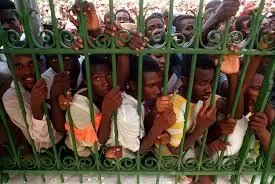
For too long, we have allowed others to shape our fate while we stood on the sidelines of our own history. We have the resources, the intelligence, and the numbers to change Haiti. What we have lacked is the organization to turn those strengths into power. The moun andeyò have carried Haiti on their backs, yet we remain excluded from the decisions that govern our lives. The new electoral decree only confirms what we already know: no one in Haiti’s center of power will open the gate for us. We need to organize our power and break down the walls of exclusion that have kept the moun andeyò outside the decisions that shape our lives.
Security, prosperity, and education are not abstract ideas. They are the foundations of dignity.
The recent round of massacres in Pont Sondé should awaken our conscience.
Dessalines warned that the presence of our enemies would accuse our guilty slowness. Haitians are not dying at the hands of the French but of other Haitians, and those responsible walk freely among us. His words ring true as if he were still alive: “Native citizens, men, women, girls, and children, let your gaze extend on all parts of this island: look there for your spouses, your husbands, your brothers, your sisters. Indeed! Look there for your children, your suckling infants, what have they become?... I shudder to say it ... the prey of these vultures.”
He went further and noted the following:
Instead of these dear victims, your alarmed gaze will see only their assassins, these tigers still dripping with their blood, whose terrible presence indicts your lack of feeling and your guilty slowness in avenging them. What are you waiting for before appeasing their spirits? Remember that you had wanted your remains to rest next to those of your fathers, after you defeated tyranny; will you descend into their tombs without having avenged them? No! Their bones would reject yours.
The Haitian Declaration of Independence
That warning is true today, and it can also be our turning point. The moment demands that we rise together and claim the future we owe to the next generation.
If you want to participate in this effort, contact me at johnny.celestin@icloud.com