

The American Myth Has Lifted
The Trump administration exposed a myth many of us carried about what America was and what it guaranteed, not by diminishing American power, but by stripping away the story that once framed it.
If there were any doubt, the United States’ overnight military operation in Venezuela should resolve it. The United States remains the most powerful country in the world, economically, militarily, and politically. While its dominance has eroded at the margins, it is still the only true global superpower. What has collapsed is not American power itself, but the narrative that surrounded it. For generations, that narrative suggested that power was restrained by principle, that dominance carried responsibility, and that force ultimately answered to law.
President Trump did not create a new reality. He revealed an old one by abandoning the language that once softened its edges. History shows how powerful nations divided the world among themselves. We are living through another such moment.
For decades, American power was wrapped in the vocabulary of rules, norms, and shared values. Even when those ideals were violated, they mattered because they imposed limits. They demanded justification and forced hypocrisy, which was cynical but still constrained behavior. What President Trump has demonstrated is what power looks like when it no longer feels obligated to perform restraint at all.
Power Without Apology
Trade and tariffs offered an early demonstration of this shift. President Trump’s economic nationalism (America First) exposed how dependent the global economy remains on the United States. That dependency has long been symbiotic. Because of its dominance, America has been able to borrow trillions of dollars at low interest rates, financing domestic consumption while absorbing the labor and resources of other nations.
Much of what is consumed is disposable. Goods move rapidly from factory to landfill, often poisoning ecosystems far from American borders, in countries that bear the environmental costs of prosperity they did not meaningfully share in creating. This system enriched the United States while hollowing out others, yet it endured because it was framed as part of a rules-based order that balanced power with responsibility.
President Trump did not discard that framing so much as clarify what power looks like when it no longer feels compelled to justify itself to allies, institutions, or norms.
The same logic appears in the military sphere. Russia’s invasion of Ukraine exposed how dependent even Europe remains on American power. Despite being attacked on its own continent, the European Union has struggled to respond without U.S. weapons, intelligence, and security guarantees.
The Russians’ boldness did not emerge in isolation. It was enabled by American inconsistency over time. Hesitation under one administration followed by indulgence under another sent a clear signal that even when the United States remains dominant, its commitments are conditional and subject to political whim, and more importantly, political interest.
The Lessons from Venezuela
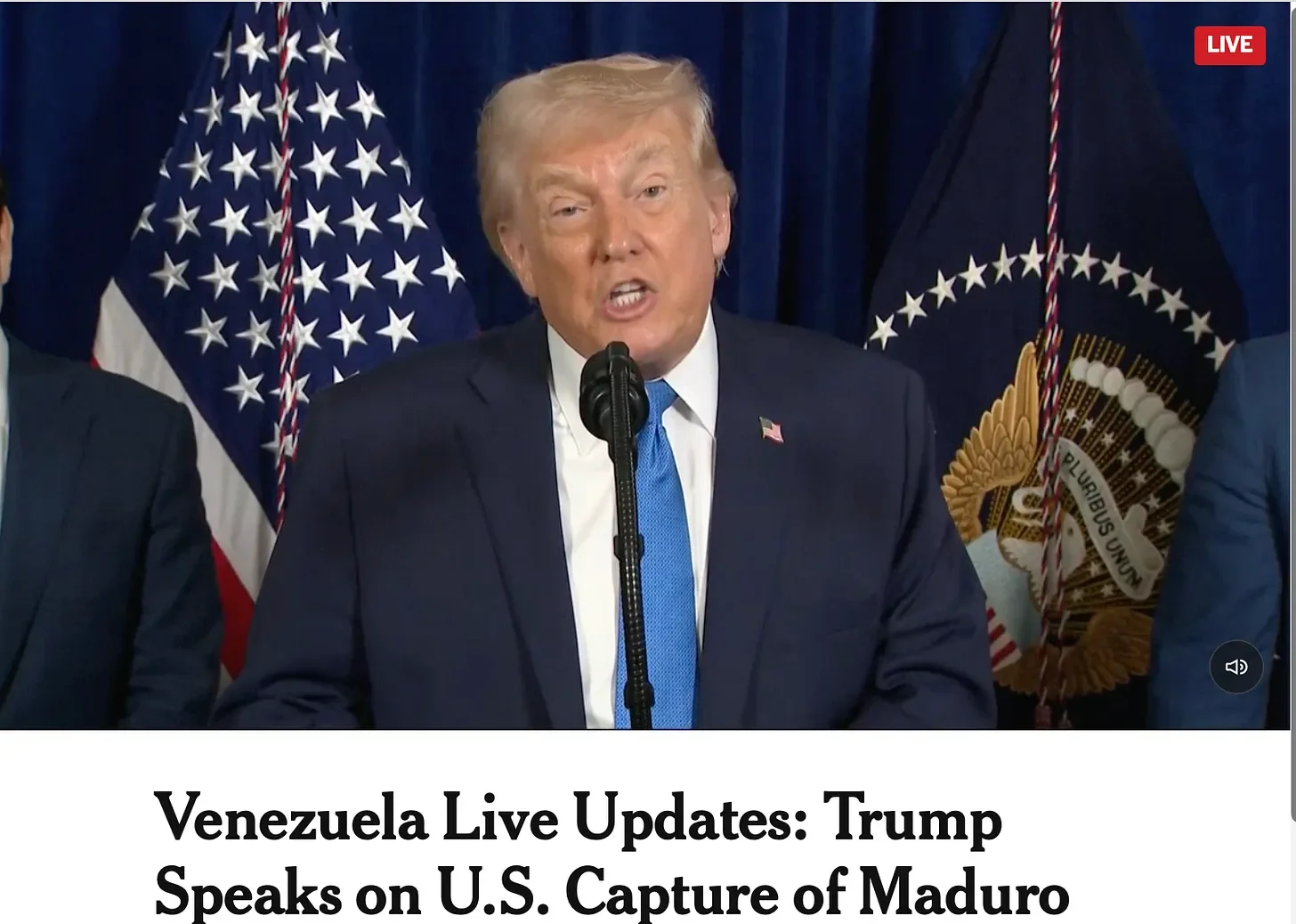
We woke up this morning to the news that the United States launched a large-scale military operation inside Venezuelan territory, captured President Nicolás Maduro and his wife, Cilia Flores, and flew them to New York to face criminal charges. The operation occurred without congressional authorization, without consultation with regional bodies, and without regard for Venezuelan sovereignty.
The justification followed a familiar script. They labeled Venezuela as a Narco-terrorist state and a national security risk. U.S. officials reframed the Venezuelan government not as a sovereign authority but as a criminal enterprise and permitted themselves to act as they chose. This framing was largely performative, designed for public consumption.
For Latin America and the Caribbean, the implications are unmistakable. Sovereignty is conditional. Leaders deemed unacceptable can be removed. Diplomacy gives way to force applied swiftly and decisively, with little recourse.
The Venezuelan operation should also put to rest a persistent illusion within Haitian political discourse. For years, some have argued that the United States has orchestrated Haiti’s gang violence to justify an intervention to steal Haiti’s hidden resources. Venezuela proves otherwise. When the United States wants something, it does not rely on proxies or conspiracies. It takes it.
The same logic applies to Haiti. The United States has already designated Haitian gangs as terrorist organizations, and if it wanted Haiti’s so-called uranium reserves, it would not need subterfuge. The Marines would land, secure whatever Washington deemed valuable, and justify the action after the fact, if justification were offered at all.
The fact that this has not happened speaks less to American restraint than to American indifference. Haiti’s crisis persists not because it serves hidden American interests but because it does not rise to the level of American concerns.
This distinction matters. Conspiracy theories offer comfort by allowing us to believe we matter enough to be manipulated. They spare us from confronting a harder truth. Haiti’s collapse is overwhelmingly Haitian-made, and America’s role is not one of an omnipotent villain but of negligent contempt.
For Haiti, the message is simple. We exist in the same hemisphere, in the shadow of the world’s superpower. We are subject to the same calculations of power. When the United States decides that Haiti’s government is a problem, or that its instability threatens American interests, it will act.
Why America Still Captivates Our Imagination
Last week, I traveled through Tanzania, a country of extraordinary beauty and abundant resources. Like many nations across Africa, it is rich in land, minerals, and human potential. Yet much of that wealth is extracted by foreign interests, often at unfair prices, with limited benefit to the population.
Africa is not poor. It is resource-rich. That colonial powers looted the continent is history. That extraction continues today under new contracts and new flags is harder to excuse.
This is not simply the fault of those who extract. Power follows interest. Capital follows advantage. As the proverb reminds us, se sòt ki bay, enbesil ki pa pran. What remains difficult to accept is that people of African descent, despite centuries of experience, still struggle to internalize how power operates. We protest exploitation while failing to build the institutional coherence required to stop it.
Haiti is not an exception. We follow the same pattern.
Learning the Rules of Power
Some countries have begun to draw different conclusions. In the Sahel, Mali, Niger, and Burkina Faso have rejected security arrangements they view as perpetuating dependency. Their choices are controversial and risky, but they are rooted in realism rather than appeal.
Algeria reached a similar conclusion decades earlier, following a brutal war of independence against France, by solidifying sovereignty through language, administration, and institutions. Arabic was embedded in the machinery of the state.
In East Africa, Swahili increasingly functions as a shared language shaping education, governance, and regional coordination. This is not symbolism. It reduces division and dependence on external systems and may one day extend beyond language to shared economic structures.
These examples remind us that nations that endure organize themselves around reality, not false aspiration.
Who Pays First When the Law Collapses
When the rule of law erodes, it is never the powerful who bear the consequences first. It is Black communities, migrants, the poor, and those already treated as disposable. Practices once tested at the margins are eventually normalized and applied at the center.
For Haitians, this reality is not theoretical. Haiti has long existed in a world where sovereignty is conditional, and violence is justified in the name of order. We know how easily security replaces justice and how quickly Haitian lives become acceptable collateral.
The Venezuelan precedent makes this vulnerability unmistakable. If the United States can seize the president of a country with tens of millions of people, vast oil reserves, and international allies, it is fair to ask what restraint would apply to Haiti. We are smaller, poorer, more dependent, and widely more chaotic. We possess no strategic resource to bargain with, no powerful allies to protest on our behalf, and no meaningful capacity to resist militarily.
The practical question is not whether the United States could do in Haiti what it did in Venezuela. The question is what, if anything, would prevent it. That uncertainty should concern every government in the Caribbean Basin.
But more worryingly, in a world where raw power is exercised more openly, neighboring states will adjust their behavior. Borders harden. Deportations accelerate. Security doctrines intensify, and humanitarian language gives way to enforcement.
For the Dominican Republic, which already frames Haiti primarily as a security problem, the erosion of restraint lowers the cost of actions that once carried diplomatic consequences.
Many Haitians take comfort in invoking 1804 and believing that some collective defiance will protect us again if the Dominican Republic decides to act as the U.S. has in Venezuela. I am not convinced that such a response is available today, or at the pace at which Haitians are being killed by a few thousand armed gangs while the state remains largely absent.
What unfolds in Haiti will not remain contained within its borders. It will shape regional norms, harden neighboring policies, and redefine how vulnerability is treated across the Caribbean. In a hemisphere where power is becoming more explicit and less restrained, Haiti’s weakness does not inspire solidarity. It invites raw power calculation.
Building a New Myth, Built on Accountability
This is why the collapse of the American myth matters beyond America’s borders. It is not because the myth was ever fully true, but because it imposed limits and forced performance. Once even the performance disappears, the vulnerable are left exposed.
The Venezuelan operation removes any remaining ambiguity. Power will be exercised. Sovereignty will be violated. Leaders will be removed. Justification will follow interest rather than principle.
This reality also clarifies something Haitians must confront honestly. For too long, our political imagination has been oriented toward external guarantees. We substituted urgency for strategy and improvisation for discipline. In a world where myths are collapsing, that posture is no longer survivable.
If the era of borrowed myths is ending, Haiti must define its own, not rooted in rescue or fantasy but in accountability and collective discipline. Leadership must be bound to institutions rather than personalities. Politics must be grounded in responsibility rather than spectacle. The nation must be organized to protect its people rather than plead to be protected.
This work is slow and unspectacular, but it is the only form of leadership compatible with a world stripped of illusions.
The United States has shown us what power looks like when it stops pretending. The myth is gone. What remains is responsibility, and that responsibility is ours.