

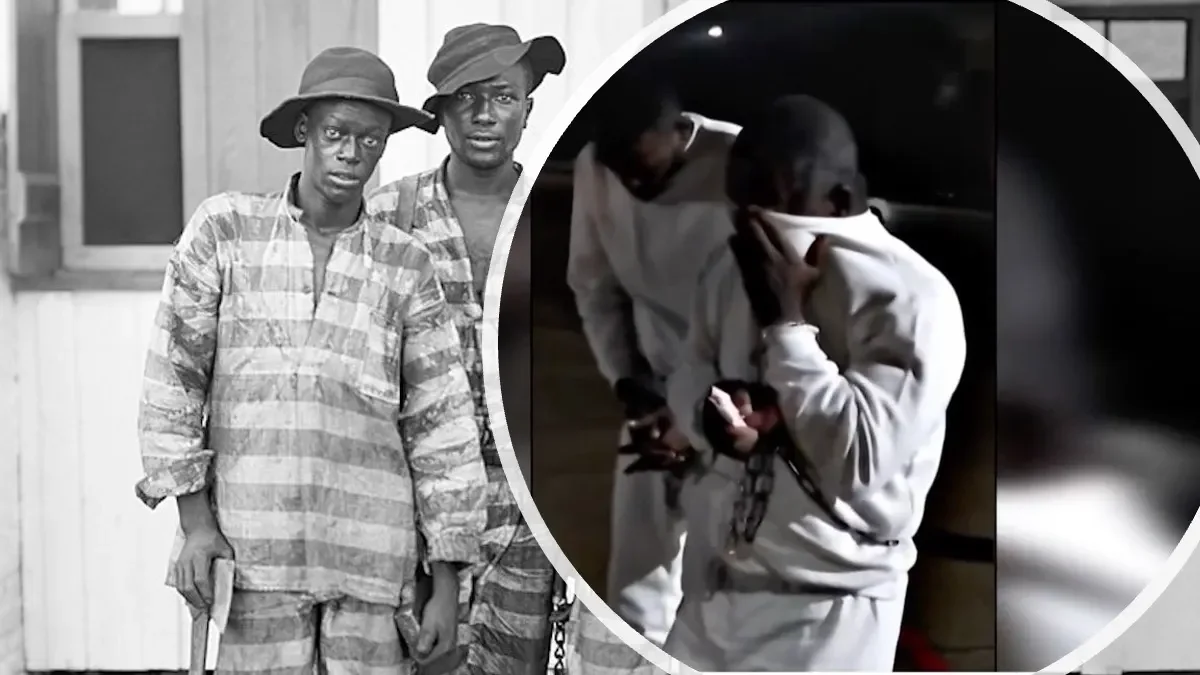
On August 28, the Department of Homeland Security posted a video showing a number of Black men, shackled at the wrists and ankles and chained at the waist, boarding a deportation flight to Haiti. When I first saw the video posted on various WhatsApp groups, I assumed it was fake. The shackled men shuffled slowly through pouring rain while an upbeat Haitian song played over the footage. I thought that the scene was too surreal to have been recorded and posted by an actual agency of the United States government. I was wrong, and I shouldn't have been surprised.
It was not only real but also another illustration of how our government turned the deportation of 161 human beings into a demonstration of its own cruelty. Someone deliberately chose the imagery, the pacing, and the soundtrack, and it was as Kafkaesque as it could be.
As a black man, what immediately came to my mind were the lynchings of Black men once staged as public spectacles, entertainment for white families and a deliberate instrument of fear against the Black American community. Of course, the images of Black men in chains belong to that same brutal American lineage stretching from enslaved Africans transported by force across the Atlantic. This continued through the Jim Crow era, and into the contemporary systems of racial control that Michelle Alexander examined in her book The New Jim Crow.
Today, the video features Haitians because our community is its initial target, but we are not the only audience for whom it is intended. It is also aimed at every Black and Brown community targeted by this administration, including Americans whose families have been here for generations.
We should be incensed and horrified by the ways the Trump administration is abusing its power, pulling the nation back to a period many believed was behind us. Our condemnation and resistance are necessary in the short term but insufficient in the long term. They also should not prevent us from studying the source of that power and thow it’s been used. The stakes require us to understand how political power, especially on the right, can act this aggressively while comparable political agency seems unavailable when those on the left take power.
Despite having the support of roughly only a third of Americans, mainly the MAGA base, President Trump has governed with remarkably few political constraints as though he possesses an overwhelming mandate. He has repeatedly tested political and institutional constraints that others often treat as absolute before the fight even begins.
Some of those constraints are real and necessary. Presidents should be constrained by the Constitution and the law. Congress does require compromise, and institutions matter. Other limits, however, are political conventions, norms, and expectations that progressive leaders have too often accepted as untouchable and presented as limits on what they can accomplish.
This was not always the progressive understanding of power. Franklin Roosevelt assumed the presidency amid economic catastrophe and used the power available to him, together with an organized political coalition, to fundamentally reshape the relationship between Americans and their government. One of his greatest achievements was Social Security, which once represented a radical expansion of the federal government’s responsibility for the economic security of ordinary people, became one of the enduring institutions in American life.
Trump has therefore exposed something that progressive history has repeatedly demonstrated. A disciplined political movement that arrives at the right moment, with a leader willing to exercise power, can rapidly alter government policy, challenge institutions, redefine what is politically acceptable, and compel its own coalition to fall in line.
The lesson is not that we should imitate Trump’s politics, his disregard for institutions or the rule of law, or his cruelty. It is that we should stop allowing our leaders to convince us that they, and therefore we, lack the agency to change things for the better.
Power is also the Choice Not to Act
If political will determines how far leaders are prepared to push the power they possess, then Trump forces us to ask a more uncomfortable question about our own leaders: what have those we elect as progressives chosen to do, or not to do, with theirs?
Trump has, in a sense, taken away an alibi. His presidency does not prove that institutional constraints are imaginary, but it makes it harder to accept automatically that meaningful change is impossible, must wait for a more favorable moment, or can come only incrementally.
We should therefore be more demanding when politicians who sought our votes promising change acquire that power and then tell us how little can actually be changed.
Few examples make this contradiction clearer today than Hakeem Jeffries, who co-sponsored Medicare for All in 2019 and again in 2021. Now, as progressives mobilize against the Trump administration and Jeffries stands a real chance of becoming Speaker of the House if Democrats regain the majority, he has reversed his position. He told NBC’s Meet the Press in August that Medicare for All is “not legislation that I currently am cosponsoring or that I support,” while distancing himself from what he called the DSA agenda. Another is Senator John Fetterman, who has undergone a mind-boggling political shapeshift, moving from someone once embraced as a champion of progressive working-class politics to a senator who now describes his party’s leftward movement as “lunacy” and an “orgy of socialism.”
At the same time, while the Trump organization is carrying out its own orgy of destruction, the centrist group Third Way has committed $15 million to a campaign not aimed at Trump but at diminishing the influence of the Democratic Socialists of America after DSA-aligned candidates began winning primaries against candidates backed by the party establishment. Those who benefit from the existing distribution of power are investing to preserve the status quo. The question for progressives is whether we understand the lesson and are prepared to act with our own agency by organizing, investing in, and supporting alternatives to the centrists who have too often defined the boundaries of what our politics can become and, ultimately, our policy choices.
These reversals cannot be dismissed as political timidity.
They force us to ask whose interests carry the greatest weight when politicians acquire power and why the policies they once championed become negotiable as their power grows. However, asking the question is not enough. If establishment forces are willing to organize against the progressive wing of their base and invest millions to preserve the status quo, we must exercise our agency by building and supporting alternatives. Our responsibility cannot end with choosing among candidates presented to us or electing people we hope will remain faithful to their promises. We must organize into a movement that can shape those choices in the first place, back leaders who represent our interests as they acquire power, and keep that movement alive so we can hold them accountable to the people and principles they were elected to represent.
Next week, I will examine what the lesson has exposed about what agency means for nations struggling to exercise their sovereignty, and ultimately for Haitians confronting the question of who will determine Haiti’s future.
Frederick Douglass warned that “power concedes nothing without a demand.” Our experience adds another lesson, which is that power concedes nothing to the unorganized.