

Screen capture from UN Meetings Coverage and Press Releases - https://press.un.org/en/blog/sc16444
On July 20, Haiti’s Foreign Minister, Raïna Forbin, addressed the UN Security Council with a message of hope. “We are closer than we have been in years to restoring security and holding free, credible, inclusive, and participatory elections,” she told the Council. Unfortunately for Ms. Forbin, reality had other plans. Barely a month later, the gang Viv Ansanm attacked the locality of Kenscoff again. During the night of August 23 into August 24, they killed at least 47 people, including twenty-two executed at a church compound where people had sought shelter, and abducted more than 50.
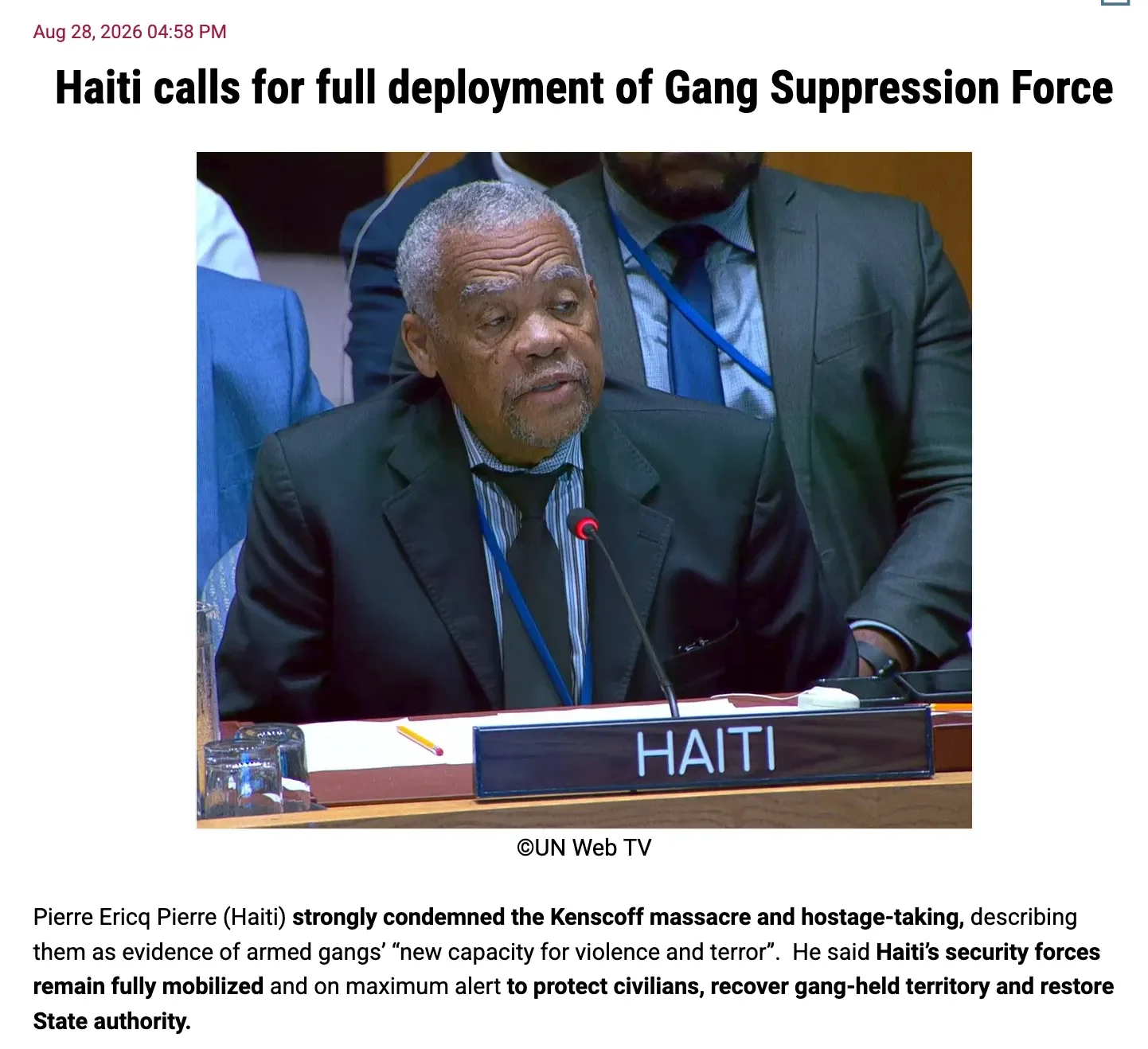
As with past massacres, the de facto government repeated the same refrain, condemning the violence while forgetting that its primary duty is to protect its citizens. Yesterday, August 28, during a UN Security Council briefing, Haiti’s UN envoy, Pierre Ericq Pierre “strongly condemned the Kenscoff massacre and hostage-taking, describing them as evidence of armed gangs’ “new capacity for violence and terror”. He said Haiti’s security forces remain fully mobilized and on maximum alert to protect civilians, recover gang-held territory and restore State authority.
To genuinely address this crisis, we cannot allow the Haitian government’s disregard for its people to be accepted or normalized.
There Are No Expendable Communities
Far too many fellow Haitians use the statement “ Pòtoprens pa Ayiti - Port-au-Prince is not Haiti,” usually to remind the world that gangs do not control the entire country. The government makes the same argument. In her UN speech last July, Ms. Forbin claimed that seven of Haiti’s ten departments are ready for electoral activities without any major security impediments. I understand the impulse to show that the rest of the country is still functioning, but Haiti will not survive if we continuously redefine it as whatever territory the gangs have not yet taken.
Violence in Cité Soleil or Village de Dieu once seemed limited to those neighborhoods alone. People in Delmas once believed that Solino was not their problem, and those in Pétion-Ville believed Kenscoff was someone else’s. Each time another community falls, those not touched by the violence reassure themselves that most of Haiti is still safe and standing. I have seen YouTubers partying in Léogâne to show how safe it was, but today, as the gangs have taken Gressier, it (Léogâne) is close to falling as well. We must ask ourselves: at what point do we begin to understand that whatever happens to a Haitian, wherever they may be, affects all of us? How many Haitians are we prepared to leave behind enemy lines or what the government calls the “lost territories”?
I believe the line we must draw is that every Haitian life carries equal weight.
A mother hiding her children from gunmen in Pont-Sondé has the same claim on her country as one putting her children to bed in Cap-Haïtien. Anything less creates different classes of Haitian citizenship. And that has been the central challenge to creating a cohesive nation since our founding.
The result is that the lost or abandoned territories become fertile ground for armed groups to recruit new members and collect more “tolls,” which they use to buy more weapons to terrorize the population and seize even more territory.
We must understand that solidarity with another community is not charity when our survival is interconnected. It is self-preservation.
As Haitians, we understand sacrifice. We work two jobs to send money to a mother, pay a sister’s school fees, cover a cousin’s hospital bill, or help a friend rebuild a home. Yet, that sense of responsibility weakens when the person in danger is a stranger in a place we do not know. Our collective challenge is not to teach Haitians solidarity because we practice it to the tune of upward of $4 billion a year, but to organize it beyond family and hometown until the Haitian we have never met belongs to that same circle of love and even responsibility.
Trust Is a Key Security Infrastructure
Meeting that challenge requires trust, which the government lacks, and a point that most security plans treat as secondary. The fact is, the armed gangs cannot be defeated without it.
We often focus on armored vehicles, weapons, and more trained police officers and soldiers. While these matter, the real battleground is on the ground because victory will not come from the air. Haiti’s armed gangs are deeply embedded within the population, a condition that represents both a strength and a weakness for them. Indeed, the ordinary Haitian who is kept as a “hostage” also knows the back roads and the locations of weapons caches. This knowledge makes their involvement essential. This war depends on their participation, and that participation will not happen without trust, something this de facto government currently lacks.
Local residents must trust that the information they share will be acted on, that their communities will be protected from retaliation, and that the security forces will remain after the territory is recovered.
Trust is not a soft addition to a hard security strategy. It is part of the intelligence infrastructure itself.
The government can purchase weapons and technology, but it cannot purchase the confidence of a mother deciding whether telling the police what she saw will protect her children or get them killed.
The Failure to Mobilize Haiti
This may be the Fils-Aimé government’s most consequential failure. It has never offered the country a credible strategy and asked Haitians to organize behind it. Moreover, despite an increase in their budget, Haiti’s security forces remain reactive, showing up only after communities have been destroyed.
The government reportedly committed about $52 million to a security arrangement with Erik Prince’s Vectus Global, which conducts armed drone operations. It is odd that a government willing to spend tens of millions on foreign expertise has made no comparable effort to mobilize its own people, even as it engages in an existential war.
A national mobilization would begin with Haiti’s human capacity, from former police and soldiers to the neighborhood self-defense groups and Haitians abroad ready to contribute resources and expertise.
What is missing is not Haitians’ willingness to contribute, but a strategy for organizing these resources.
Mobilization does not mean every Haitian carrying a weapon, an idea that is as impractical as it is dangerous. It means treating Haitians as participants, not spectators. It must also be clear that while international assistance may support Haiti's strategy, it can never substitute for it. Haiti’s greatest unused security resource is the Haitian people themselves, but unorganized potential remains only potential.
Indivisibility Must Be Organized
Despite their continued failure, we must keep demanding that those in power fulfill their first obligation: to protect the population. I believe that literally everything is secondary, including elections. While this balance is difficult, we must also accept that those in power may be too incompetent or may be benefiting from turning a blind eye to the destruction.
This is why we, Haitian citizens, must build structures that turn our individual acts of solidarity into collective power.
The government bears responsibilities that citizens cannot take on, especially regarding the lawful use of force, but we also have our own duties. We must organize ourselves to convert solidarity into collective strength. Without this effort, we are just millions of Haitians making great sacrifices alone, while the country as a whole becomes more vulnerable.
Nou Kanpe begins with the conviction that Haiti belongs to all of us and therefore imposes responsibilities upon all of us. We must see and believe in a Haiti that is indivisible, but repeating those words will not make them come true in practice. We must build the relationships, trust, and organization that give them meaning. No Haitian community should suffer alone. An attack on one must draw the concern and the strength of us all.
That is what it means to say Nou Kanpe. We stand.