

The nightmare many Haitian families in the US have long feared is here. We are moun andeyò in the truest sense, a term long used to diminish Haiti's rural majority as people from outside, and as Haitians living abroad, we carry that same exclusion with us wherever we live.
This past week, more than 160 people were deported to Haiti, the first such flight since Temporary Protected Status ended for some 350,000 Haitians. As has been the case since November 2024, U.S. airlines have been barred from flying into Port-au-Prince after gangs shot at several commercial jets. The country is so unsafe that the State Department has restricted US citizens’ travel to Haiti, and the US embassy operates with only minimal security personnel because the risk is considered too great.
Washington knows exactly how dangerous Haiti is, but it is sending Haitians back regardless. Cruelty is the point, and deporting Haitians back proves it.
Some of those who now face deportation have calculated that the administration cannot possibly deport all 350,000 of them at once. Their calculation is rational, but they miss that it is not just about the numbers. The goal is likely not to deport everyone, but instead to frighten the millions who are undocumented and turn them into an invisible underclass living in permanent fear.
More broadly, it is the first salvo in a larger campaign against Black and Brown people, whether they are immigrants or US-born, and it has reached beyond the undocumented to Black and Brown citizens who have themselves been swept up by ICE. While immigrants are focused on ICE, the same administration is systematically erasing Black and Brown heroes from the collective imagination as it renames military bases after Confederate soldiers, scrubs the names of Harriet Tubman, the Tuskegee Airmen, and the Navajo Code Talkers from federal websites, and strips a Black brigadier general’s name from an Army base to restore a Confederate one in its place.
There are no accidents, and erasing the record of the black heroes who helped build and defend this country is not incidental; it is part of a project in the works since the South lost the Civil War and refined by successive generations.
We are living through the confluence of a movement that has finally met the moment and the leader it needed to execute it, though surely not as flawlessly as they might have hoped.
We should have no illusions that Haitians are the canary in the coal mine. We are absorbing the early blows in a struggle over race, citizenship, and belonging that has run through this country for centuries. We are the skin and bone paving a road that is being colored red with our blood, and that road will eventually reach those who believe they can be bystanders.
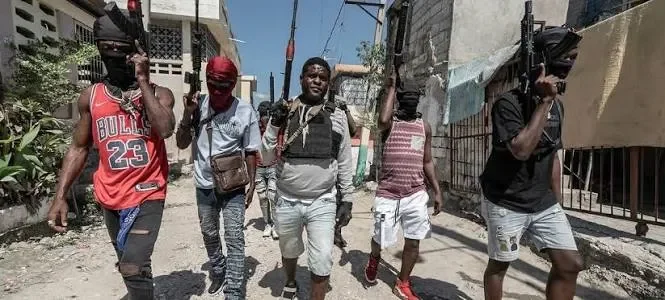
There are many Haitians who believe there is an international conspiracy against Haiti. It may be so, but that cannot excuse our own, whether gangs or political leaders who have long treated Haitian lives as expendable. Indeed, Alix Didier Fils-Aimé, the de facto prime minister who came to power by luck rather than a mandate, continues to prove that our own leaders can be even more cruel to Haitian citizens than any foreign power. This past July, gangs massacred more than 60 people in Kenscoff and forced thousands to flee. Two days ago, they returned and killed at least 47 more.
I have resisted the claim that this government is complicit with the gangs it claims to be fighting, but after each massacre goes unanswered, it becomes harder to accept that this is merely incompetence.
According to a UN report, more than 3,100 Haitians were killed between January and June of this year alone. Given this, it is not hard to understand why some Haitians would prefer to live underground in the US rather than return home.
However, those massacres do not determine our story. I believe we can write a new chapter by standing up against this corrupt political class and the gangs that it sustains and which in turn keep it in power. While this moment may seem bleak, we have the power to make Haiti the homeland we return to, instead of one we run from.
We Have Been Andeyò Too Long
After decades of disappointment with American politicians who reneged on their promises and with Haitian politicians who have run the country like an occupying army looting the treasury on its way out, it is understandable that some of us have concluded that politics is corrupt, that voting changes nothing, and that organizing is exhausting. I understand why withdrawal can feel like self-preservation, both mentally and physically, but I do not believe we have the option to withdraw. Every system built on concentrated power benefits when ordinary people decide that participation is useless.
Our adversaries do not need to silence us if they can convince us that speaking accomplishes nothing, nor do they need to take our power if we surrender it ourselves. Giving up simply hands more of it to whoever remains in the fight.
Some who have responded to NOU KANPE have urged us to start small by choosing something concrete, building trust, and learning and growing. I agree that a movement cannot merely describe the power it hopes to build, but starting small does not mean thinking small. Haiti already has too many dispersed organizations. NOU KANPE does not need to create another project alongside them. Our challenge is to offer a vision, earn trust, and build the connective tissue that turns streams into rivers and, eventually, raging rapids. It is to turn the strength that already exists into collective power.
The upcoming elections in Haiti and the United States offer a practical place to begin. Organizing around them requires us to identify people, train volunteers, register voters, research candidates, build alliances, and move people from concern to participation. After Election Day, those relationships, skills, and organizing structures become the foundation for what comes next.
Organizing ourselves cannot mean isolating ourselves.
We need alliances with African American and other Black and Brown communities confronting many of the same forces now targeting us. Not all skinfolk are kinfolk, and every struggle has its Judas willing to sell his people for thirty pieces of silver. But the reverse holds as well. Not everyone who looks different from us is our adversary.
The civil rights movement was unapologetically rooted in the struggle of Black Americans, and people of other races still marched and died alongside them without making that movement any less Black. NOU KANPE must be just as unapologetic about organizing Haitians while welcoming those who share that principle, so that when we stand with others, we bring organized people, not empty hands.
We Must Reclaim Our Place
For generations, moun andeyò have financed, fed, defended, mourned, and loved Haiti while remaining outside the places where its future was decided. We have repeatedly demonstrated our commitment, but we have not built collective power commensurate with that commitment.
Home is supposed to be where we return when every other door closes.
If Haiti has become a place Haitians fear returning to, our answer cannot be surrendering our claim to it. Our responsibility is to help make home worthy of returning to, while building enough power wherever we live so decisions about Haitians can no longer be made as though we are spectators to our own future.
We have been andeyò long enough, and we cannot afford to remain there.
Nou Kanpe. We Stand… for dignity, responsibility, and collective power