

As we witness the depths of cruelty a society can reach, many of us feel angry, powerless, and increasingly hopeless. These feelings are real, raw, and often overwhelming. They are part of our story, but they need not define it. We still have the power to write what comes next.
Nelson Mandela described courage not as the absence of fear but as the willingness to act despite it. This moment does not require us to be fearless. It requires us to decide what we will do despite our fear.
When I think about what Haitians are experiencing in the United States and around the world, my anger is directed first at Haitian leaders who have failed to show love, care, or responsibility for their own people. That does not minimize the deliberate cruelty Haitians are experiencing elsewhere. But long before other countries began deporting Haitians en masse, Haiti had already begun pushing its own people out, whether it was the moun andeyò in rural areas excluded from the nation’s life, or the millions of us who left and built lives abroad. We call it deportation and get angry when Haitians are forced out of other countries, but it began at home, when our own leaders started treating us as a commodity to be traded away.
Under the Duvaliers, the Haitian state rented out desperately poor Haitians to cut sugarcane in the Dominican Republic in exchange for payments to the government. Decades later, the political and economic elites’ contempt manifested in their financing of armed groups that now terrorize families and drive entire communities from their homes.
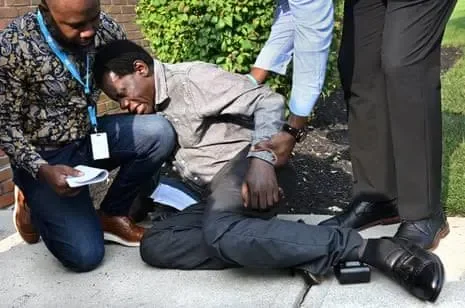
We must fight the humiliation of Haitians in the US who are required to wear ankle monitors like common criminals, and we must confront the Haitian forces that made exile necessary in the first place. We cannot demand that foreign governments respect Haitians while some of us Haitians living abroad attend the galas and dinners of the same economic and political elites who are oppressing our people and funding their killing, lending them legitimacy they did not earn or deserve.
Pise Gaye Pa Kimen
The title is a proverb that translates to “Scattered pee cannot foam.” That Haitian expression describes our condition. We are millions of people with knowledge, relationships, resources, talent, and love for Haiti, yet too much of that strength remains scattered. We respond individually to emergencies, create organizations that rarely connect, and fight yesterday’s battles while the forces shaping tomorrow become better organized.
Our greatest weakness is not that we lack strength. It is that we have not harnessed and channeled it.
Why I Still Believe
I descend from a people who changed the course of human history. They were enslaved people, divided by language, brought to a small Caribbean island far from all they knew. They rose up and confronted the armies of empires and a world organized around the belief that some human beings were born to rule and others to serve.
They came together, fought, and sacrificed, forcing an empire to its knees and compelling the world to witness a universal truth: freedom is God-given and belongs to everyone.
I also know enough history to reject the idea that Haiti is uniquely incapable of change. I think often about New York City, where I call home, a city so nice they had to name it twice. In the 1800s, it was a lawless place where Irish, Italian, and Jewish gangs fought turf wars for control of Lower Manhattan, while Chinese tongs waged their own decades-long war over Chinatown, much as Barbecue, Ti Lapli, Krisla, and Lanmò San Jou control large swaths of the West and Artibonite departments today. New York changed when citizens like Charles Parkhurst, a Presbyterian minister, gathered evidence that police captains were selling protection to criminals, forcing a reckoning that put reformer Theodore Roosevelt in charge of rooting out the graft.
Haiti is not condemned by any defect in the Haitian character. There is no Haitian exceptionalism. We are human beings with flaws and also great power, and nobody gets to tell us that Haiti cannot change. But believing Haiti can change requires something of us. It requires that we stop waiting for a savior, be disciplined, and start doing the patient work of building institutions capable of holding our leaders accountable.
Dignity, Responsibility, and Collective Power
We should be outraged when Haitians seeking safety and opportunity are treated like criminals. When an ankle monitor is strapped onto someone whose only offense was seeking a better life, the humiliation is impossible to miss.
For a people whose ancestors once carried iron around their ankles, the symbolism is impossible to ignore.
However, dignity cannot be something we only demand from others. It must govern how we treat one another, and that is where responsibility begins. Instead of always asking which government, organization, or foreign institution will solve our problems, we must increasingly ask: what can we do together for ourselves?
This is why we are building a movement around three commitments: to seek dignity, accept responsibility, and build collective power.
There are powerful forces working against the dignity and interests of our people, and the work begins by naming them. First among them is Prime Minister Alix Didier Fils-Aimé, who has signed Haiti onto an $800 million, ten-year contract with Erik Prince, the former Blackwater founder, whose private drone task force has killed more than 1,200 Haitians since last year, including at least seventeen children, according to Human Rights Watch and United Nations reporting. This is the same Erik Prince who argued on his own podcast that the United States should “put the imperial hat back on” and directly govern countries he considers incapable of governing themselves, naming Africa and Latin America outright.
We may have feelings about Erik Prince, but it is the Haitian prime minister who is paying him with Haitian taxes to kill Haitians. I will submit that our outrage should be directed not only at the colonizer but also at the willfully colonized.
Here Am I
Many people who have read my recent articles have asked what comes next, and others have reached out to offer help or urged me to step forward more publicly. I have resisted because I have watched the system destroy those who stood against it, from Martin Luther King and Malcolm X to Marcus Garvey, W.E.B. Du Bois, Medgar Evers, and Assata Shakur, and the list goes on. I am not comparing myself to any of those warriors as I cannot even stand in the shadow of their light. I also know my imperfections, and in the current political climate, I would be lying to myself if I did not worry about what greater visibility could mean for the people close to me and who care for me. Nonetheless, the moment calls for sacrifice. This is why I am involved in the NOU KANPE (We Stand) movement for the dignity of Haitians specifically and Black people more broadly.
The movement is a work in progress as we assemble a team of capable patriots ready to stand now, because waiting for the perfect moment, movement, and leader has already cost our people too much.
In this historical moment, I invite you to stand, to come as you are, and to share of your gifts and talents. Bring your knowledge, relationships, skills, time, resources, questions, and even your doubts, because there is work for those who can organize, build, teach, listen, contribute, or simply bring others together.
We already have the moment. Building the movement is our responsibility now. The leader will emerge.
In the Book of Isaiah, God asks, “Whom shall I send? And who will go for us?” Isaiah answers, “Here am I. Send me.”
Whether or not you are of Christian faith, there is a profound truth in that exchange. There are moments when we recognize that something must be done, look around hoping someone else will step forward, and ultimately ask whether we are willing to become the people we have been waiting for.
Will you stand and seek dignity, accept responsibility, and build collective power?