

Fuzzy Allegiance Leads to Chaos
The Vagabondage and Haiti’s dysfunction were not imported.
“Fuzzy allegiance leads to chaos.” That was how a friend recently summarized his distrust of Haitians with dual citizenship during a debate. In his words: “Anpil moun ki soti nan diaspora a yo fè anpil vakabondaj nan peyi a, kraze, piye, volè, epi lage pye yo pou retounen nan peyi kote ki bay lòt paspò a.” Haitians who come from abroad, he argued, return only to destroy, steal, and plunder before retreating to the country where they hold another passport. A second passport, in his view, inevitably produces a divided loyalty. His proposed solution was mandatory renunciation of any other citizenship for those seeking to serve in the public sector, whether elected or appointed. By associating the breakdown of the rule of law with our citizenship status, as though the nation’s destruction rests on our shoulders, he has created a subordinate category of Haitian identity.
It is an exclusionary logic that treats the diaspora as a threat to be managed rather than a resource to be integrated.
This argument has long circulated beneath the surface of Haitian discourse, and in a context defined by scarcity and limited opportunity, it hardens into something more deliberate, a tendency to recast Haitians abroad as outsiders in order to justify their exclusion and tighten control over what little power and resources remain.
The core issues in our debate were not about policy differences; they were about a hierarchy of citizens.
A False Debate During a Time of Crisis
This resentment is especially jarring when set against what is actually happening on the ground. Just days before our exchange, the United Nations Human Rights Office documented a staggering toll: over 16,000 people killed and 7,000 injured since January 2022, with thousands massacred in 2025 alone and over 1,500 women and girls victimized by sexual violence in that same period. Since our conversation, the Gran Grif gang descended on Jean-Denis in Petite-Rivière de l’Artibonite. Human rights groups reported that more than 70 people were killed by other Haitians while the state stood by helplessly and silently. In the midst of this carnage, a supposed friend of the diaspora is arguing that we are responsible for Haiti’s chaos because of our “fuzzy allegiance.”
The contrast reveals how far we have drifted from the central problem. This debate replaces an urgent focus on security and institutional reform with a symbolic argument about identity, and in doing so, it weakens our collective response to a national emergency.
How can I trust the person next to me in a battle for Haiti’s soul when they do not see me as an equal?
If “vagabondage” is the true litmus test for public service, then we must apply it honestly to the men and women who actually have held the keys to power. From the Duvalier dynasty through the presidencies of Aristide, Préval, Privert, Martelly, and Moïse, Haiti’s corruption, impunity, and eventual collapse were not imported; they were engineered from within. The record is a ledger of homegrown betrayals. Today, those who are sanctioned under the Global Magnitsky Act, including Prophane Victor, Luckson Elan, Gary Bodeau, Rony Celestin, Fednel Monchery, and Joseph Pierre Richard Duplan, do not have a second passport. They are Haitians who have worked to dismantle and hollow out the state. Jean-Claude Duvalier alone siphoned as much as $800 million from the national treasury, securing a legacy as one of the most corrupt leaders in modern history. None of this devastation was the work of dual citizenship. It was the predictable, systemic outcome of unchecked power in a system that protected the predators.
The ruin of Haiti was signed, sealed, and delivered by those who stayed and kept one passport.
The Hierarchy of Citizenship
What this friend is proposing is not a minor eligibility adjustment. It is the deliberate creation of a subordinate class of Haitian identity. Under his model, Haitians Andeyò are permitted to send remittances, build the clinics and schools abandoned by the state. Indeed, we may even be allowed to vote, but we are disqualified from leadership. The motto is: " We need you to help Haiti, but stay away."
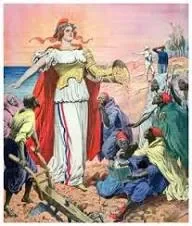
This contradiction has a name that survivors of the French empire know in their bones. Under French colonial rule, the indigène was present in the territory but never fully of it, granted just enough status to be useful while being denied the rights that would make them equal. Haiti’s founders went to war in 1804 to destroy that distinction. It is a bitter irony that some of their descendants are now working to resurrect it, not for foreigners, but for Haitians. How ironic that Maarten Boute, Digicel’s former CEO, is Haitian, but I am viewed with suspicion as a Haitian American.
We Destroy Our Own
The scale of Haiti’s crisis demands the full engagement of all Haitians, regardless of where we live. It is common sense that nations in crisis cannot recover by reducing the participation of their citizens wherever they may be. They recover by expanding the coalition and by building institutions that can channel participation into results. The focus must be on creating systems that enforce the law, protect citizens, and hold leaders accountable. That work cannot be accomplished by drawing lines that separate Haitians from one another.
This debate reminded me of two proverbs. An old Italian one says: “I’ll protect myself from my enemies; may God protect me from my friends.” The other, closer to home, says: “All skin folks ain’t kin folks.” I had understood both abstractly, but this recent conversation brought them home in a way I did not anticipate. The person who raised this argument has himself lived in the diaspora. He has sought our advocacy, invoked our shared history, and called on our support when it suited him. And yet he views us as partial Haitians whose “fuzzy allegiance leads to chaos” in Haiti. This is not a simple policy difference. It is a strike at the core of our identity, and it reveals the central challenge of our struggle: the profound distrust between Haitians is the Achilles heel of our nation. It is precisely why foreigners will always have the upper hand without lifting a finger. We destroy our own.