

A Nation That Forgets Its Dead Has Already Lost Itself
We taught our children everything — except what was sacred.
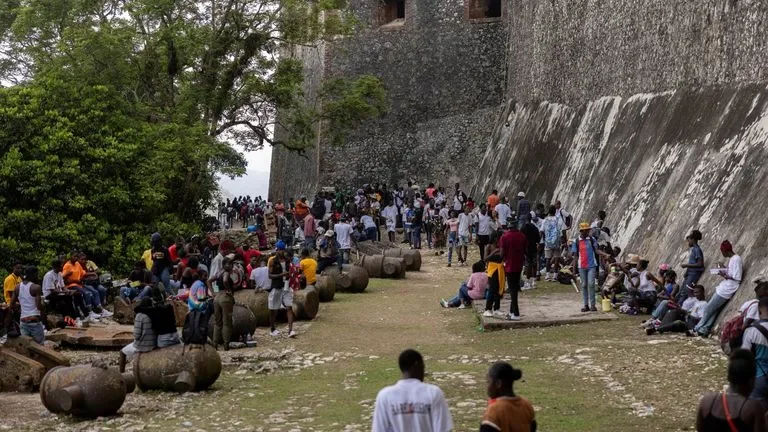
In recent weeks, I have not been able to write about anything, especially Haiti. This silence has brought me both relief and sadness. The relief comes from the exhaustion that thinking about Haiti has become, especially as I witness the ongoing destruction not only of the country but also of something deeper, the gradual erosion of what should be unchangeable in us as a people. The sadness stems from the growing sense that I am not wanted there by my fellow Haitians, and that the Haiti I carry inside me and the Haiti that exists in the world are two separate stories. Despite this, I continue to write about it, out of duty, out of love, out of restlessness, driven by a persistent connection to a place in perpetual crisis that, somehow, still endures. I write as a form of resistance and, more importantly, as a way to exist in the world.
Despite so many tragedies, April 11 hit me particularly hard. Thirty-one young people, around my daughter’s age, died painfully and unnecessarily at a moment that was supposed to be about joy. Their faces were unknown to me, yet impossible to separate from hers.
They died in a place our ancestors consecrated with their blood, defiance, and the sheer force of knowing who they were.
Many of them likely did not know they were dancing on the same ground where King Henri Christophe, who built the Citadelle, is buried on its ground.
Beneath my grief for the lost souls lay a lingering question I had long avoided: what has my generation done with the inheritance of our ancestors? What have we failed to learn and pass down, enabling those who orchestrated that event to feel no natural taboo or internal resistance against turning a site like the Citadelle Laferrière into a backdrop for celebration?
Thirty-one dead, and they are already a distant memory
When thirty-one young lives are lost, the questions society raises afterward expose its true condition. A community rooted in what is sacred will ask how this occurred, who bears responsibility, and which structural flaws enabled it. Our public officials bear real responsibility for this tragedy, but so do we, those of us who failed to instill in our youth the reverence that should have made the Citadelle feel sacred rather than just a location. to hold a party.
The identities of the thirty-one victims who suffocated at the Citadelle remain unknown, and even if we knew them, they would likely be forgotten, just as we have forgotten Evelyne Sincère, the 22-year-old student who was kidnapped, tortured, and left dead in a dump. We also forgot about Eliana Thélémaque, whose two-month-old baby was murdered by gang members in Kenscoff when they ordered her to throw him into a fire. She begged and refused, but they tore the baby from her arms and threw him into the flames. For two weeks, Eliana wandered in shock, repeatedly telling anyone who would listen, “Mwen toujou tande rèl pitit mwen nan flanm yo... Mwen ta prefere mouri,” or in translation, I still hear my baby’s cries in the flames... I would have preferred to die. She eventually died of grief. We have moved on from Evelyne, from Eliana, and from her baby, who never had the chance and was sacrificed at the altar of power, money, and influence.
A mere two weeks later, the Citadelle is off the headlines.
The conversation shifted to gang attacks in Seguin. We have opened another front on Haitian social media, which has turned into a bitter, fratricidal fight over two young women who have excelled in the only place they could, which was outside of Haiti. Ariana Lafond, a Haitian TikToker, won the House of Challenge 2026 in Togo, and Abigaïl Alexandre, became the first Haitian to win the Eloquentia international oratory contest in Paris. Yet their accomplishments have become occasions for criticism, division, and competition.
In a country plagued by repeated tragedies, our tendency to forget might be a survival instinct, but it has become a dangerous political habit that prevents accountability, and the transformation tragedies should inspire. We learned nothing lasting from January 12, 2010, when more than three hundred thousand people perished. We mourned but quickly returned to normal, as if grief alone were enough rather than the reckoning it required.
What colonization started, our own neglect completed
My generation failed to pass down our history and did not turn the Citadelle into a place of pilgrimage, reflection, and reverence. We did not teach young Haitians its significance, not as mere tourist spots or cultural scenery, but as the tangible evidence of what a people can achieve when they understand clearly who they are and what they are fighting for.
Our cultural and physical heritage has deteriorated under Haitian stewardship, and what little preservation remains, whether of historical sites, public institutions, or the infrastructure that binds communities together, is often financed by institutions tied to the very powers our ancestors defeated.
Even our roads, our hospitals, and our schools are sustained by international actors.
These institutional failures, though significant, are secondary to the failure across generations. My generation has the responsibility to instill in Haitian youth the understanding that the land beneath their feet was not merely historical but sacred. We failed to do so, and it is unreasonable to expect any generation to protect or feel accountable for something they were never taught to love.
The gods we were given, and the gods we abandoned
Every enduring society has thrived by preserving a strong link to its mythology, which is not seen as mere fiction but as a shared story that shapes a people's identity, mutual responsibilities, and essential boundaries. These living systems of meaning define what is sacred, and once you grasp what is sacred, you inherently know what needs safeguarding.
As Haitians, we are familiar with Greek gods like Zeus and Athena, yet we remain unaware of our own history. When you ask an educated Haitian about Ogou Badagri, the war strategist, or Ogou Feray, the warrior spirit who wields the fire of resistance, or about Ezili Dantò, who embodies beauty, sorrow, and love, most often they pretend not to know or feel ashamed. We understand the gods of the civilization that enslaved our ancestors better than the spirits that sustained them through that oppression. This isn’t accidental; it’s the most effective curriculum ever forced on a defeated people. Over generations, we’ve absorbed and internalized their stories, reciting them proudly rather than questioning them.
Our people also have their gods, myths, and stories.
The Yoruba incorporate their Orisha into every ceremony, every praise song, and every rhythm of the dùndún, the talking drum that encoded history, law, and identity into sound, allowing even the illiterate to know who they are and where they come from. The Fon people of Dahomey, whose descendants brought Vodou to Haiti across the Atlantic, once sat on three massive ceremonial thrones, including King Behanzin’s grand throne, and gathered in palaces with four ornate wooden doors carved with the complete history of their civilization. Their warriors, the renowned Dahomey Amazons, an all-female military unit known for discipline and ferocity, left behind sacred objects that embodied their people’s spiritual authority. For over a century, those thrones, palace doors, and sacred objects were held in Paris at the Musée du quai Branly, where French schoolchildren studied them as symbols of a civilization the French military once defeated. France returned them to Benin only in 2021, after generations of sustained advocacy made inaction indefensible. This is also our history, and it is impossible to teach a Haitian child that she is the descendant of great kingdoms when the king’s throne was displayed in someone else’s museum.
Indeed, even the remnants of Haiti’s founding documents have followed a similar path. The only known original printed copies of Haiti’s 1804 Declaration of Independence are stored in the British National Archives, not in Port-au-Prince or Haitian institutions. I am glad the documents survived and that the founding text of the world’s first Black republic hasn’t been entirely lost. However, I feel only shame from knowing that the document our ancestors wrote with their blood is safer in London than in Haiti, protected from our own government’s neglect and gangs that have vandalized our historical sites. This relief offers no comfort; it is a confession.
What Bwa Kayiman built, and what we accepted to forget
Before Haiti declared itself a republic, its people were united by an enduring system of meaning, memory, and ancestral connection that colonizers could not erase. Vodou, rooted in the Fon language and spiritual traditions of Dahomey, was more than a religion. It established social rules, mutual obligations, and a shared moral community among enslaved Africans from different regions and languages, binding them to one another and to their ancestors. The Loas (spirits) that Haitian ancestors called upon at Bwa Kayiman traveled with them through the Middle Passage, survived slavery, and were indispensable in organizing the revolution. That ceremony was not merely symbolic. It was a moment of collective remembering that made everything that followed possible, including the army, the battles, and the Citadelle itself.
The Citadelle is not separate from Vodou. It is Vodou’s most enduring monument.
For more than 500 years (509 as of today), we have been and continue to be taught to feel ashamed of our ancestral tradition. After the devastating earthquake in Haiti on January 12, 2010, which left more than three hundred thousand people dead, Pat Robertson, the American televangelist, claimed on the Christian Broadcasting Network’s 700 Club that the 1791 Bwa Kayiman ceremony was a pact with the devil and that the earthquake was divine punishment. If he were alive, I would tell Robertson to go to hell, but the harsher truth cuts closer to the bone - closer to home. Many Haitian Protestants shared his view, treating a colonial judgment against their own ancestors as wisdom rather than recognizing it as the shame it represents. My mother did not teach us about Vodou, and in my ignorance, I haven’t passed it to my daughter - three generations interrupted. I believe this is common; we inherited something sacred and learned to see it through the lens of those who feared what it had already allowed us to achieve. It can never be the colonizer’s responsibility to teach us about our own greatness.
Grief without reckoning is just another form of forgetting
My daughter graduated yesterday and will now embark on her journey into the world with the same hopes, anxieties, and zest for life that surely united her with the thousands of revelers who gathered at the Citadelle that night. Had we been able to stay in Haiti, she might have been one of them, and that thought has lingered with me since April 11, because in the Haiti I grew up in and in our African tradition, it takes a village to raise a child, which also means it takes a village to lose one, and we lost thirty-one.
Those young people are our children, and we owe them more than grief, because grief without reckoning is just another form of forgetting.
We are a people who have become estranged from our history, our gods, our ancestors, and the meaning embedded in the ground we still walk. I sometimes feel unwanted in Haiti, but I will never stop feeling responsible for it. The honest accounting is this: my generation received an extraordinary inheritance and failed to transmit it with the seriousness and love it demanded. We have not taught our children what is sacrosanct. We have not made them fluent in their own mythology the way colonizers made us fluent in theirs. We did not give them the instinctive reverence that would have made April 11, in the bones of everyone present, feel like a transgression before it became a tragedy.
The investigations have already begun, the reports are being written, and the press releases have been issued. These performative acts will run their course, as they always do, and change nothing, as they never do. The accounting that matters most will not be conducted by any institution. It is the question each member of my generation must sit with, about what we passed down and what we allow time to erase, about the village we were supposed to be responsible for, and whether we are willing to become the kind of people who deserve what we were given before we lose another generation to our own estrangement.