

If a tree falls in the Forêt des Pins and no one in Port-au-Prince hears it, does it make a sound?
Why Haitian mobilizations keep falling short
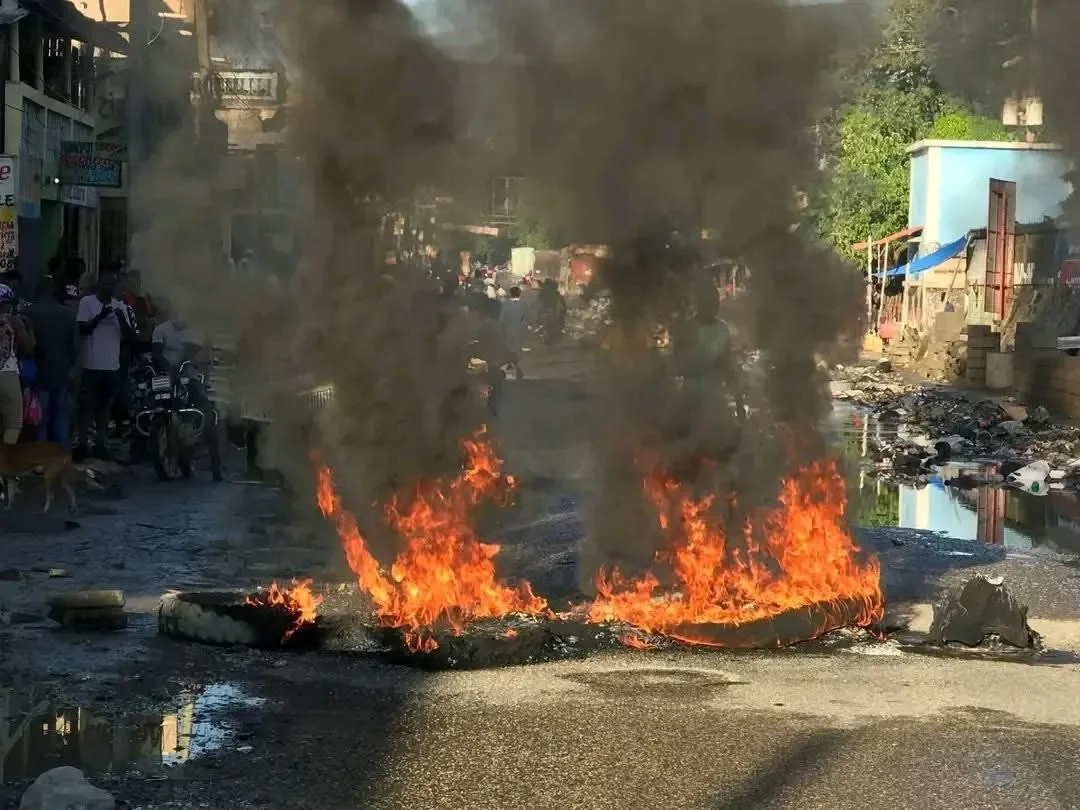
In recent weeks, two movements have emerged in Haiti. One calls for reopening the country’s main airport, and the other demands that the roads connecting the towns of Kap Ayisyen and Wannament be freed from gang control. These movements reflect the frustration of a population experiencing the full impact of those closures on the economy and their survival.
Citizens demanding action from their leaders is a fundamental aspect of democracy. However, they seldom lead to any sustainable solutions and sometimes no response at all. We must analyze why this happens in Haiti and why the government ignores its citizens.
The answer is actually fairly straightforward. Like the tree falling in the Forêt des Pins, the Haitian government does not ignore protests because of distance but because the essential connections between it and its citizens are broken. In a healthy democracy, elections serve as a vital link. The leaders who disregard their citizens risk losing their positions. However, Haiti has not held credible elections for years. Another broken connection is taxation, which deserves a closer look.
The demand to reopen the airport is legitimate, but I believe it is limited because what most Haitians need is not to reopen the airport but to free the national roads that are controlled by gangs.
The daily reality for ordinary people is not about air travel. It is about having to negotiate with armed groups to get around and move goods between cities. It is about the national roads that have become toll corridors, and about a daily life defined by restriction, scarcity, and hardship. Reopening the airport without restoring road access speaks more directly to those who can leave than to those who must stay.
It is important to recognize that the airport is not closed because those in power do not care, but because it is profitable. While the movement leaders’ focus is on the international community, what this misses is that a parallel economy has taken hold, one where private sector actors and gang networks move in the same direction even without formal coordination. Flights are routed through charter arrangements. Boats and barges move people and goods at inflated prices. The economic elites who finance and facilitate these arrangements, alongside the armed groups that control territorial access, are not suffering from the airport’s closure. They are benefiting from it.
The diaspora, whose family obligations require them to navigate these roads and buy the basic necessities of life regardless of costs, is the group burdened by this system, on top of several other taxes already applied to their transfers in both the U.S. and Haiti.
The Anatomy of a Captured State
The government’s primary financial ties are not with the protesting citizens but with the importers and private-sector actors who pay customs fees. Most citizens are taxed indirectly on their purchases. The duties and fees are collected upstream, at the port, paid by importers and distributors who pass the cost down through every item on the market. By the time a protest breaks out and a road is blocked, the state has already captured its revenue. As a result, road closures disrupt the population, as food stops arriving, life becomes more unbearable, and daily hardships worsen. However, this does not affect the unelected leaders running the country. This is why blocking roads is too often a self-inflicted wound rather than the political weapon it should be. The people who feel the tree fall are the ones living beneath it.
The diaspora community sits at the center of this arrangement in ways most of us have not fully reckoned with. We send money, our families spend it on imported goods, and the state collects its share at the port, taxing us through a system that was never designed to represent us and that gives us no organized mechanism to demand accountability. The Fonds National de l’Éducation makes this concrete. Since 2011, $1.50 has been levied on every remittance transfer under the explicit promise to get 1.5 million children into school, yet, as I wrote in “The Fight for the Dignity of Our Citizenship,” they raise hundreds of millions of dollars, but no credible public accounting of those funds has ever been published. According to Human Rights Watch, approximately 1.2 million Haitian children remain out of school today, and the levy continues to be collected without transparency or consequence.
The Remittance Myth and the Konbit Alternative
At numerous conferences, I hear the same argument: Haitians abroad remit over $4.1 billion annually, demonstrating the community’s wealth and the resources available for investment. The prescription that follows is that the diaspora can and should contribute more, as if the issue were simply a lack of funds rather than underlying conditions.
This framing is both incorrect and unfair to those sending money. According to data from Haiti’s Central Bank, the most common transfer amount is $150, and 45% of transfers fall between $100 and $500. The BRH describes the typical sender as a blue-collar worker. The Migration Policy Institute confirms that Haitian immigrants in the U.S. are more likely than other groups to work in service jobs, less likely to have college degrees, and typically report lower household incomes. These are hardworking individuals using their limited resources to support their families, not wealthy professionals choosing consumption over investment.
The $4.1 billion in remittances reflects a collective sacrifice, quietly draining diaspora communities and closing opportunities for many who cannot afford to invest in themselves.
The better question isn’t how to extract more from already overextended people, but how to organize existing resources to carry political weight alongside their economic role. Our tradition of konbit is the only viable framework because it brings existing efforts together to achieve outcomes that no single effort could achieve on its own. As I discussed in “Retail Politics” and “Why Haiti’s Majority Moun Andeyò Needs a Movement,” fragmented, uncoordinated efforts create a false impression of participation while maintaining the current power dynamics. Specifically, this means our remittances could fund community schools rather than just individual school fees, support local agricultural cooperatives rather than the import cycle that taxes us without our consent, and contribute to health networks rather than only crisis responses.
Konbit does not require more money, but it requires coordination, trust, and the discipline to build enduring solutions beyond the next crisis. And that is my call to action for community leaders.
What We Owe the People in Those Streets
The trees are falling on the streets of Kap Ayisyen, Wannament, and even Pòtoprens, but neither the government nor the diaspora community seems to notice. The diaspora elite has drunk its own Kool-Aid and is unwittingly doing the government’s bidding by asking working people to make greater sacrifices. Meanwhile, the government, fully aware of this dynamic, actively promotes the investment narrative to keep diverting resources from the very citizens to whom it remains unaccountable.
As I wrote in “We Keep Improvising. That Is the Problem,” we know how to mobilize in times of crisis. What we have not built is the infrastructure to convert mobilization into power and sustained pressure. I believe that infrastructure begins with choosing konbit over charity or remittances, collective institutions over individual projects, and the majority’s survival over the minority’s convenience.
We have many organizations in the diaspora that claim to represent Haitians, and it's crucial that we collaborate to raise Haitian voices both locally and internationally. Without this unity, the tree in Forêt des Pins will keep falling, and those in power in Port-au-Prince and the chefs-lieux des départements will remain deaf to the people’s needs and demands.