

Nations Are Forged From Fire. Haiti Cannot Escape That Reality.
The birth of a nation is never clean, and it is rarely peaceful.
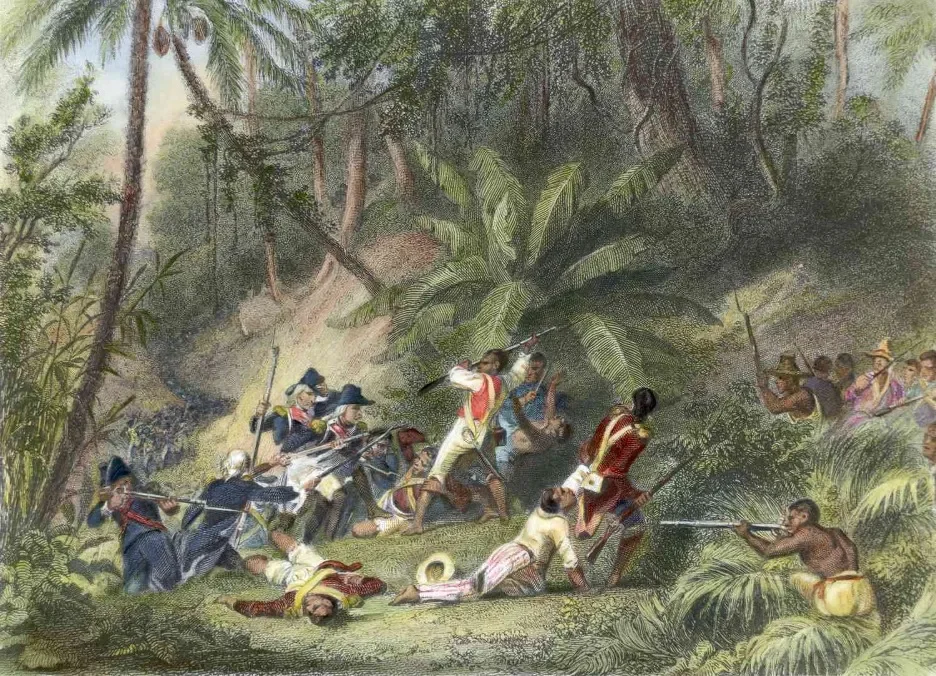
We tend to see so-called “advanced” nations through rose-colored glasses and think of them as if they developed in an orderly, institutionally guided, consensus-driven manner. History tells a different and considerably bloodier story. In France, the Revolution of 1789 removed the king but created something far more dangerous — a savage contest among factions for the soul of the new republic, in which the moderates and the radicals fought each other as ferociously as they had fought the monarchy, until the Vendée region descended into a civil war that left an estimated 150,000 dead and the Reign of Terror sent thousands to the guillotine. France did not become France by declaring the rights of man; it became France when Napoleon Bonaparte emerged from the wreckage with consolidated power, imposed the Code Civil across the entire territory, and forced a fractured nation to recognize a single legal and administrative order.
England’s history was no less violent. The Civil War of 1642 was not just a conflict between King Charles I and Parliament but a struggle over who held ultimate authority over the nation’s fate, culminating in the king’s execution. Oliver Cromwell, after defeating the Royalists, wielded both executive and legislative power at the same time, directing the country’s future through sheer force of will. His mistake was not in holding this power but in failing to establish institutions that could outlast him, which is why the Commonwealth fell apart within two years of his death and why England had to go through the Glorious Revolution of 1688 before its national rules were finally written down. Germany presents the clearest example of all. In the mid-1800s, the German-speaking world was a patchwork of over thirty separate states sharing a language but little else, and Otto von Bismarck did not unify them through speeches or votes but through three deliberate wars against Denmark, Austria, and France, describing his strategy without apology as the policy of “blood and iron.”
In more recent times, the pattern repeated itself without sentimentality.
The United States would be a fundamentally different country had it not fought the American Civil War, which pitted the industrial, union-centered vision of the North against the agrarian, slaveholding order of the South, and settled by force what decades of political compromise had failed to resolve. Rwanda rebuilt a centralized state from the wreckage of genocide in 1994, its military victor imposing a governing order with a totality that left no ambiguity about who would define the country’s future.
On the other hand, Burkina Faso tells the cautionary version of this story. Thomas Sankara came to power in 1983 with a genuine revolutionary vision, vaccinated two million children in three weeks, championed women’s rights, and told the IMF what it could do with its structural adjustment programs, but he never secured the ideological contest, never built the institutional foundation to protect his program, and on October 15, 1987, soldiers loyal to Blaise Compaoré, his former close ally and comrade shot him dead and reversed nearly everything he had constructed. Sankara’s story is not a warning against revolutionary ideas; it is a warning against revolutionary ideas that mistake moral authority for institutional consolidation.
These examples are not moral endorsements of violence. They are reminders that nations are not negotiated into existence. They are forged, and the forging requires heat. In that heat, competing centers of power are brought into alignment or decisively defeated, and the winner, ideally a nationalist, uses that victory to build institutions that endure.
Haiti’s Unfinished Phases
Haiti’s trajectory was similar to that of these other countries, but it didn’t fully complete the process, and it has been dealing with the consequences of that unfinished journey ever since.
What the Haitian Revolution accomplished in 1804 sits in a category of its own in the history of human freedom. We did not simply win independence; we dismantled the logic of colonialism at its root, defeated the armies of Napoleon’s France along with those of Britain and Spain, and established the first nation in the modern world founded explicitly on the principle that no human being could be owned by another. That achievement did not merely resonate across the hemisphere; it terrified every slaveholding power on earth and gave enslaved and colonized peoples everywhere a living proof that liberation was possible.
There is simply no way to fully express how transformative this moment was in world history.
Haiti’s independence was Phase One. It should have been followed by Phase Two, the internal struggle over power and national direction that every nation must eventually resolve. That struggle began almost immediately. On October 17, 1806, Jean-Jacques Dessalines was ambushed and killed at Pont-Rouge by his own generals, and the young republic fractured along lines of race, class, and competing visions of the state. Henri Christophe established an autocratic kingdom in the north, while Alexandre Pétion built a republic in the south. These were not simply rival governments; they had fundamentally different ideas about authority, land, labor, and how Haiti should be governed, and neither side was strong enough to impose its vision on the other. I say this as a progressive who instinctively identifies with Pétion’s democratic aspirations: what Haiti needed then, and arguably still needs today, is the Christophian vision — the willingness to impose order and build institutional capacity before distributing its benefits.
When Boyer finally unified the country in 1820, it was not because the ideological contest had been decided but because Christophe, facing a rebellion by his own soldiers, took his own life. There was no victor, only exhaustion, and the unresolved argument was submerged beneath the next generation’s crises rather than settled.
Two moments in the twentieth century offered Haiti another chance. Dumarsais Estimé was elected president in 1946, representing something truly new—a government focused on the Haitian majority rather than the traditional elite. However, a patronage network and the military helped Estimé get into office and remove him in 1950 just as easily because his power was not based on a victory on the battlefield. He did not forge his power through the heat of war. The same logic applied to Leslie Manigat and to every other Haitian leader whose hold on power depended entirely on the favor of those who arranged their rise.
You cannot build a stable nation when the force that installed you retains the right to remove you at will.
Haiti has never truly entered Phase Three, the stage where political competition occurs within accepted rules and institutions are widely recognized as legitimate, because Phase Two was never completed. Every coup, contested election, and period of foreign intervention over more than two centuries has been a repeat of the same unresolved debate about which vision of the country should prevail, which class controls the state, and what Haiti ultimately is.
Haiti is not fragile or failed. Haiti is unfinished, and that distinction is critically important for understanding what this moment calls for. A fragile state can be shored up with aid and diplomacy. A failed state can be rebuilt from the outside. But an unfinished nation is something altogether different — it is a birth that has stalled in the canal, painful and dangerous not because something has gone wrong but because the hardest part of the process was never completed. The child and the mother are both at risk not from disease but from the absence of the decisive force that would end the ordeal and begin the life that was always waiting on the other side.
An Accident of History With Consolidated Power
This brings us to Alix Didier Fils-Aimé and to a moment that demands honest analysis before judgment.
Fils-Aimé did not win office through an election or an ideological contest. He was handed authority by the collapse of a failed council, which means he cannot be fully certain of his grip on the security forces that surround him. He watched what happened to Jovenel Moïse, who was democratically elected and still ended up assassinated in his own home. He understands that the Haitian and Dominican business interests controlling the country’s ports and borders represent a force that has outlasted every government that tried to confront it. Controlling that territory is the third rail of Haitian politics, and taking it on without overwhelming political and actual force would be suicide. He has neither in sufficient supply on his own, which is why he needs President Trump — not just for political cover but for the resources required to fight a battle that no Haitian government has yet won.
This is why what may look like surrender to the US might be a calculated gamble, however unlikely that reading seems. Trump views international relations as purely transactional, and the Prince contract — worth hundreds of millions to a man who is both a major Trump donor and the brother of Betsy DeVos, Trump’s first-term Secretary of Education — may be the price of admission for American backing against the oligarchies that have strangled Haitian sovereignty for generations. A similar arrangement was considered under Martelly, though with an Israeli firm rather than an American one, which suggests this kind of thinking is not new in Haitian political circles. What makes the Prince's choice uniquely offensive is that this is a man who has publicly declared himself a colonialist and called for governing African and Latin American countries he considers incapable of self-governance, which is to say, a man who believes people who look like us should return to a condition that 1804 was expressly designed to end forever. But again, for Fils-Aimé, this may not be about sentimentality. He may believe that if his calculation is correct and this arrangement breaks the oligarchy’s grip, history may eventually call it an improbable stroke of statecraft.
The weight of available evidence does not suggest that Fils-Aimé is implementing such a strategy, but we should nonetheless consider the possibility.
According to a March 2026 report by Fondasyon Je Klere, his administration has signed at least three contracts totaling no less than $137 million with foreign private companies to handle prison construction, security operations, border control, and tax collection. The details are worth sitting with: one prison contract runs fifty years and could cost Haiti more than $6 billion over its term; $35.5 million has already been paid to Prince’s security firm, Vectus Global, with the airport still closed, not a single gang leader neutralized, and the national roads still under gang control. These are the core sovereign functions that define what it means to govern. A state that cannot collect its own taxes or manage its own prisons is not consolidating. It is liquidating.
Again, this evidence does not suggest that Fils-Aimé is operating with a grand strategy. The political accord he signed in February 2026 with the same actors who have long resisted structural change is not the signature of a leader who has thought carefully about how power gets used once it is consolidated. Fils-Aimé has the power to write the history books as Estimé did, using a rare moment of authority to build something that genuinely served the Haitian majority. He also has the power to join the longer list of leaders who treated consolidated authority as an opportunity for extraction. The FJKL report offers serious evidence that Fils Aimé’s judgment is suspect, and at best, compromised.
The Work We Keep Avoiding
Those of us abroad must stop avoiding this conversation because the comfortable illusion that we can influence Haiti from afar while staying disorganized among ourselves is just that — an illusion. No Haitian government has ever had a real incentive to include us, and there are no strong signs this one will. The exclusion of Haitians abroad is not an accident; it’s a feature of a political system designed to concentrate power among those already inside it. In fact, this is endemic, and indeed, many of those who pretend to be allies, attend conferences and speak about the importance of Haitians abroad, are not allies at all.
They will join hands but rob us blind when we go to Haiti to invest in their schemes. Those of us who invest ourselves often lose everything to a system that offers no protection for capital that hasn’t paid homage to the right networks. Those running for office face such a deep structural disadvantage that success nearly always means entering the very patronage system they aim to reform. Even the nonprofit sector, despite its genuine generosity, provides the means to extract wealth from Haitians abroad. We also give the government an escape route—when we fund clinics or schools, we lessen the pressure on the state to build what it can only sustain. And our remittances, vital to individual families as they are, feed an economic system based on imports rather than local production, making it much easier for the government to collect revenue at ports than to tax citizens and support domestic industries. In ways we seldom discuss honestly, we are funding the very system that marginalizes us.
This is not an argument against generosity or engagement. It is an argument for organizing that generosity into political power because solidarity without structure cannot help build the state. We need to elect our own representatives abroad, people with a genuine mandate to advocate for us, and we need to build the civic infrastructure that makes that possible before the next election cycle.
220 years after Dessalines declared independence, Haiti is still waiting for Phase Two to be completed. Foreign interference has repeatedly pushed the country off its natural path, like a river diverted from its bed — but rivers tend to find their way back, and when they do, the return is rarely gentle. What Haitians call a lavalas, a great cleansing flood, is not a threat but a historical pattern, and it’s up to us to decide whether we are part of what gets swept away or part of what gets built in its wake. No one outside of us will make that choice, and we will not make it wisely if we remain divided.