

During the recent UN General Assembly, de facto Prime Minister (PM) Fils-Aimé addressed the Ayitian community in New York. According to a communiqué from the Primature, he encouraged Ayitians abroad to play a larger role in the country’s “vie démocratique et économique” through investment, entrepreneurship, and skills. “La diaspora n’est pas à côté d’Haïti,” he said. “Elle est une partie d’Haïti.” The diaspora is not pushed to the side but is integral to Ayiti. However, he focused exclusively on economic participation. While investment and skills are valuable, this perspective overlooks our potential role in governance.
This message is familiar to many, as both politicians and fellow Ayitians repeat it, urging those of us abroad to support “home” with our remittances, investments, and talent. Yet those same people actively work to exclude us from the state’s affairs. Some may resent the return of those who left.
Are they acting like the older brother in the parable of the prodigal son, resentful that the one who left should be welcomed home? If so, they should remember that we never squandered our inheritance. We have consistently supported Ayiti and never abandoned our responsibilities.
Our resources are welcome, but our right to full political participation remains contested.
Some respond that the law must be followed. However, the Code Noir of 1685 classified our ancestors as meubles, or movable property, owned like livestock or tools. It would serve us well to remember that legality does not always equate to justice.
Since the 2011 constitutional amendment, Ayitians who acquire another nationality retain their Ayitian citizenship. The 2026 electoral decree recognizes us as voters in Article 55, yet Article 186 prohibits campaign financing from anyone with foreign nationality. Our remittances account for approximately 16 percent of Haiti’s economy, over three times the government’s revenue. The same funds that sustain Ayiti’s economy are considered foreign if used for political campaigns.
Even the rights granted by the decree published by this government remain inaccessible. Article 384 allows Ayitians abroad to vote for President and on constitutional changes. However, Article 385 defers the specifics to a future order that the CEP must propose and the Prime Minister’s Council of Ministers must adopt; neither has acted to date. Voter registration opened July 20 and closes October 13, yet the CEP sent two delegations that began exploring a pilot diaspora vote in late August. We are yet again being taken for fools, as no serious institution would begin this process with just seven weeks remaining. These trips are clearly intended for publicity rather than genuine voter engagement.
Respectability Must Not Replace Responsibility
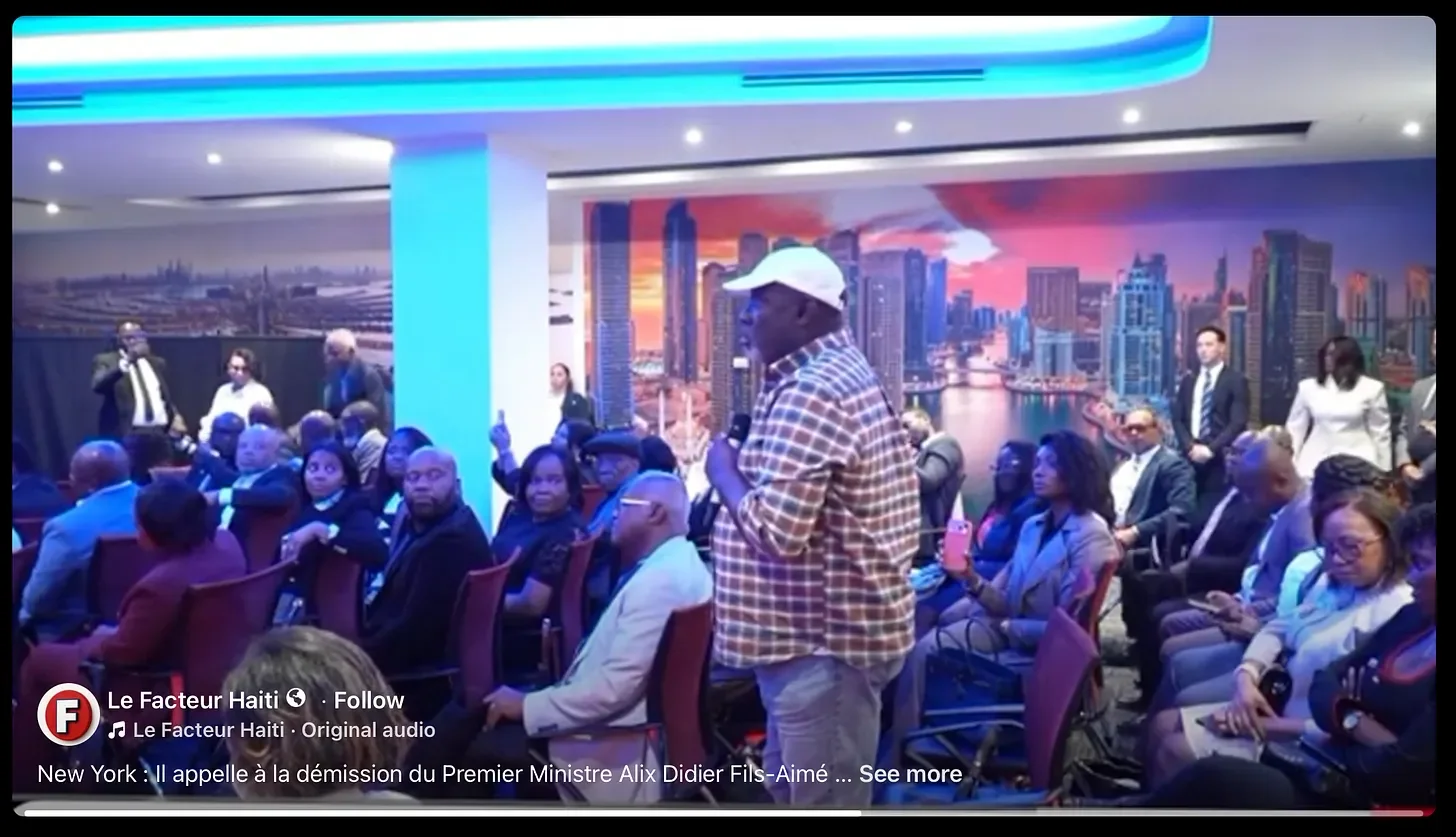
We must also be honest with ourselves. The state is not the only one responsible for this failure; we must acknowledge our role. At a New York town hall held last month while the PM was here for the United Nations General Assembly meeting, almost no one present challenged him on our rights or the security situation. When one brave man stood up and called for the de facto PM’s resignation over his incapacity to resolve the security concerns, the audience tried to silence him.
Many of us fail to assert our rights because we see ourselves as guests in Ayiti rather than as descendants.
The difference is that guests are cautious not to offend, while descendants have the right to be heard. Since 2011, every transfer we send home has included a $1.50 fee, and every international call a five-cent-per-minute charge, all in the name of a national education fund. Fifteen years later, the fund reports a treasury of 5.9 billion gourdes (over $45 million dollars at the current exchange rate), yet no one has ever fully accounted for what that money has achieved. We are taxed without representation, and still, we treat answers from public officials as a favor rather than a duty they owe us.
Too many of us sat in that room as respectable people and shushed the one person who stood up, even as news was spreading that Ayiti’s de facto government had signed a one-year, $780,000 agreement with Roger Stone’s Drake Ventures to lobby the United States government. At the same time, UNICEF projects that more than 253,000 Ayitian children under five will suffer acute malnutrition between June 2026 and May 2027. If ever there were a moment to question those exercising power in our name, this was one.
Our respectability serves those who collect our money, never the families who pay it.
Who Can Meet This Moment?
Ayiti is preparing for its first national elections in a decade, with the initial round scheduled for December 13. The same standard must now apply to those asking us to put them in power. We cannot wait until someone reaches the National Palace to begin asking difficult questions. The habits that prevent us from challenging those who hold power today will prevent us from properly examining those seeking it tomorrow.
Almost every candidate will tell us that security comes first. They will promise jobs, education, justice, sovereignty, and a government that finally works. Some will speak eloquently about Ayitians abroad and tell us how indispensable we are to Ayiti’s future. We have to demand more than the right words.
The question we must ask is whether their actions give us reason to believe they can meet this moment.
Who have they stood with when doing so carried a cost? What did they do when they possessed authority or influence? What compromises have they made to obtain or retain power? Have they challenged powerful interests when those interests harmed the country? When their personal interests conflicted with the public interest, what did they choose?
No one can spend years benefiting from the system and then ask us to believe they will be the one to change it. W
The same test applies to those of us already backing a presidential candidate. When a friend tells you whom they support, ask why, then ask yourself the same question. If you cannot explain to a neighbor what your candidate has done and what they plan to do, you are not choosing a leader. You are following a personality, and Ayiti has paid too high a price for leaders chosen that way.
Citizenship Requires Something of Us
I understand that following politics, especially Ayitian politics, is exhausting. We are inundated with WhatsApp messages, YouTube videos, rumors, and conflicting claims, all while working, raising families, and supporting friends and relatives. I understand why so many of us withdraw. Still, I believe citizenship cannot mean demanding the right to choose our leaders while accepting no responsibility for understanding the choices before us. We do not have to know everything, only enough to ask better questions.
The work we need to do cannot remain an individual effort because as the man at the town hall learned, one voice in a crowded room is easy to silence. As an organized community, we can review records, convene candidates, compare commitments, and document promises, making it possible to hold politicians accountable later. When candidates come before us, we should arrive as a constituency, not as a backdrop for the photo op.
I honestly doubt that credible elections will be held this year. Whether they are or not, I believe an organized constituency should press the same six demands I made in 2024:
Protect dual nationality in the Constitution because our right to remain fully Ayitian must be explicit and permanent, including the right to support the candidates of our choice.
Reserve seats for Ayitians abroad in the Chamber of Deputies and the Senate, so that those of us who are taxed have representatives who answer to us.
Create an Assembly of Ayitians Living Abroad to give us a permanent, elected voice in national policy.
Require that the Minister of Ayitians Living Abroad be chosen from that Assembly’s elected members, so the ministry answers to us rather than to political patronage.
Guarantee our right to vote from abroad in every national election, not only the presidential race, with clear rules published well before registration opens.
Authorize embassies and consulates to issue national ID cards. The electoral decree requires a valid card to vote, and without consular access, our right to vote remains a right on paper.
Alongside these, we should demand a full public accounting of every dollar the education fund has collected from us since 2011.
No one is coming to save Ayiti. We have spent years demanding that Ayiti recognize our citizenship, and now we must exercise it. A seat at the table means little if we sit quietly once we are there. As descendants of this country, we must organize, ask the hard questions, and raise our voices now, because once the elections are over, it will be too late.