

We Have Seen This Movie Before: Haiti’s Lesson for America
A Haitian-American Warning of How Democracies Lose Their Guardrails
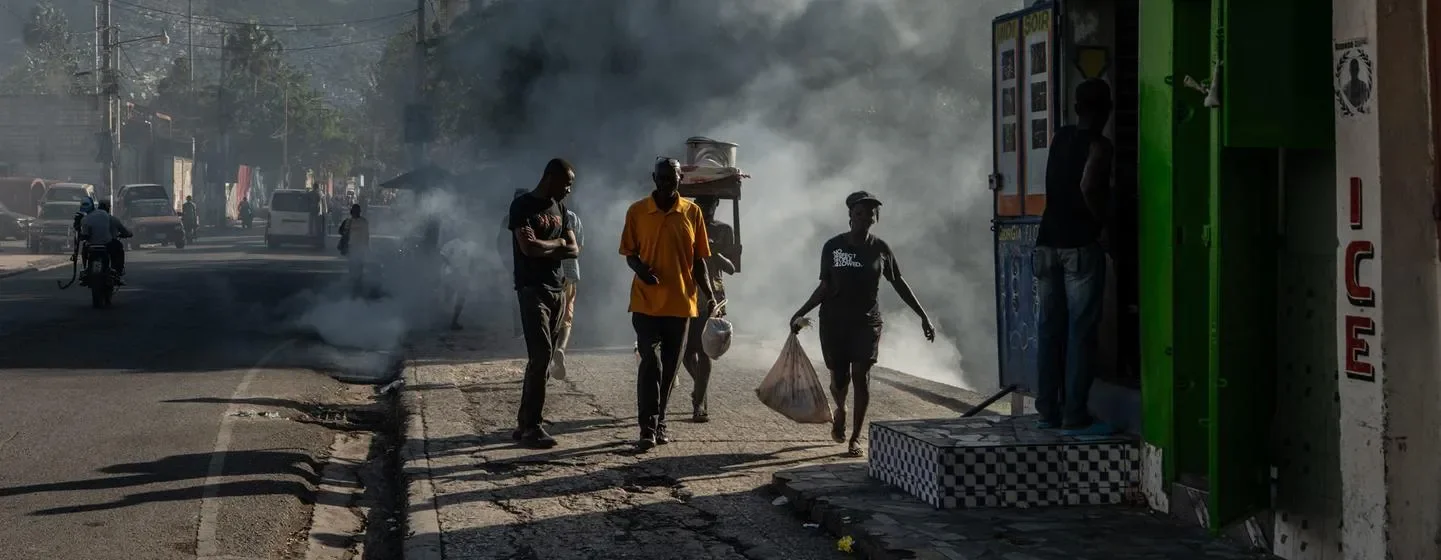
I am a Haitian-American, and my country of birth has long been governed by a ravenous minority that feeds at the public trough. They consume everything in their path, leaving the people who put them in power with nothing but crumbs over which they must fight. Again and again, Haitian leaders have treated the nation’s institutions as expendable, leaving the country weaker with each political cycle.
Haiti did not fail because it lacked formal democratic structures.
On paper, Haiti had parliaments, courts, and elections. In fact, during the American occupation in the early twentieth century, the United States even rewrote our constitution. The issue was never the absence of rules. The real problem was that leaders repeatedly undermined the constitutional balance of power among the branches of government until those institutions could no longer fulfill their original functions.
My adopted country, America, is flawed in profound ways. It began with the destruction of the indigenous people and was built on the backs of enslaved Africans. Our stories are intertwined. The same slave ships that dropped some of us in Ayiti carried others to the shores of South Carolina.
The same brutal logic turned human beings into property on both sides of that water.
Black America and Haiti share ancestry, scars, and a long history of fighting to be recognized as fully human. I came from one side of the Atlantic Ocean and built my life on the other, and this country provided me with what my birth country could not: opportunity, stability, and a rule of law I could rely on, including the freedom to write these words without fear, at least for now. That is why watching the same movie unfold in my adopted home feels deeply personal. It breaks my heart in a way I did not expect and cannot quite shake.
How a Democracy Loses Its Guardrails
President Jovenel Moïse was not the first Haitian leader to push against the limits of executive power, but he is the one whose choices we are still living with. In January 2020, the mandates of Haiti’s remaining parliamentarians expired after elections were repeatedly postponed, and instead of resolving the crisis, Moïse simply allowed Haiti’s legislature to vanish. He then governed by decree with no debate and no oversight. Judges who challenged him were removed. By the time an assassin’s bullet ended his presidency in July 2021, parliament had stopped functioning, the courts were badly weakened, and Haiti had no legitimate framework left to manage what came next. What followed was chaos. Armed groups quickly filled the space where the state once stood, and Haiti has yet to recover.
The same pattern is now taking shape in the United States, though it is unfolding in its own way. President Trump began by clearing out officials inside the executive branch who disagreed with him, including inspectors general, intelligence officers, and cabinet members who offered independent judgment. He then turned to the military’s own legal structure, removing officers from the Judge Advocate General corps, the lawyers whose job is to tell military commanders what is lawful and what is not. Removing them ensures that no one in the room feels legally bound to advise when a line is crossed. Instead, the president’s advisors are more interested in erasing the lines of good judgment, decency, and legality.
What is most alarming, however, is not the power the executive has taken but what Congress has willingly surrendered.
The tariff powers and the question of war with Iran are only the most recent and vivid examples. The Constitution places the power to tax and to declare war in the hands of Congress, and that was no accident. The founders believed decisions of such consequence required the collective judgment of the people’s representatives.
Justice Neil Gorsuch, a Trump appointee writing for the court’s conservative majority, recently reminded the country of this principle. “Legislating is hard and slow,” he wrote, and it is often tempting to bypass Congress when a pressing problem arises, but the deliberative nature of the legislative process is the whole point of its design, meant to draw on the combined wisdom of elected representatives rather than concentrating power in one man.
Yet, just yesterday - March 4, the Senate voted against a measure that would have required congressional authorization before the president could wage war against Iran. Unlike Haiti’s parliament, the U.S. Senate was not outmaneuvered by the president. It chose to set aside a responsibility the Constitution placed squarely in its hands.
A Story Haitians Know Too Well
I have seen this movie before, and I recognize the sequence as it unfolds. The dissenting voices begin to disappear. The legal guardrails give way quietly, one by one. The institutions responsible for saying no slowly empty out until no one is left to say it. Haiti’s collapse was not the product of some uniquely Haitian failure. It was the result of choices made in sequence by leaders who confused unchecked power with strength and who did not understand, or did not care, that a state stripped of its guardrails does not become more powerful. It becomes ungovernable.
The United States is not Haiti.
Its institutions are older, its democratic roots run deeper, and I do not pretend otherwise. But those of us who lived through that sequence in Haiti, who left because of what it cost ordinary people, cannot watch its early chapters unfold here without a dread that goes beyond politics. This is the country we chose. The country that gave us what our birth country could not. The country we love. And we are watching it from the same seat we occupied before, in the same theater, hoping with everything we have that this time, someone changes the ending.