

I recently watched a video of a young Haitian-American woman whose opening line I cannot shake. “Gyèt manman òganizasyon dwa zimen yo,” she said. Fuck the human rights organizations. She argued that gang members who have terrorized an entire population for years deserve no human rights, and she urged Bukele to kill them and everyone who enabled them.
Her anger echoes a broader campaign that began after November 9, when Amnesty International urged the governments of Ayiti and El Salvador to protect civilians and publish their agreement. President Bukele responded with a single word, “Ratioed,” an online taunt. His vice president, Félix Ulloa, dismissed Amnesty’s concern as “false.” Former Haitian official Mathias Pierre went full Trumpian, blaming an international “deep state.” La Derecha Diario, an Argentine outlet aligned with Javier Milei, claimed Amnesty had come out “to defend the rights of gang members.” Attacks on Amnesty have become a recurring theme on Premye Okazyon, one of Ayiti’s most popular radio shows.
As I read the comments and listened to our opinion leaders, I kept returning to a few questions. Why do calls for transparency and the protection of civilians provoke such hostility? What does our anger reveal about us, and when did we decide that human rights no longer matter?
I believe one way to understand this shift is that after years of watching the state fail to protect innocent families, when Haitians hear any call for restraint, they feel that it is a defense of the gangs.
However, blaming human rights organizations for the gang problem is like blaming the smoke detector for the fire.
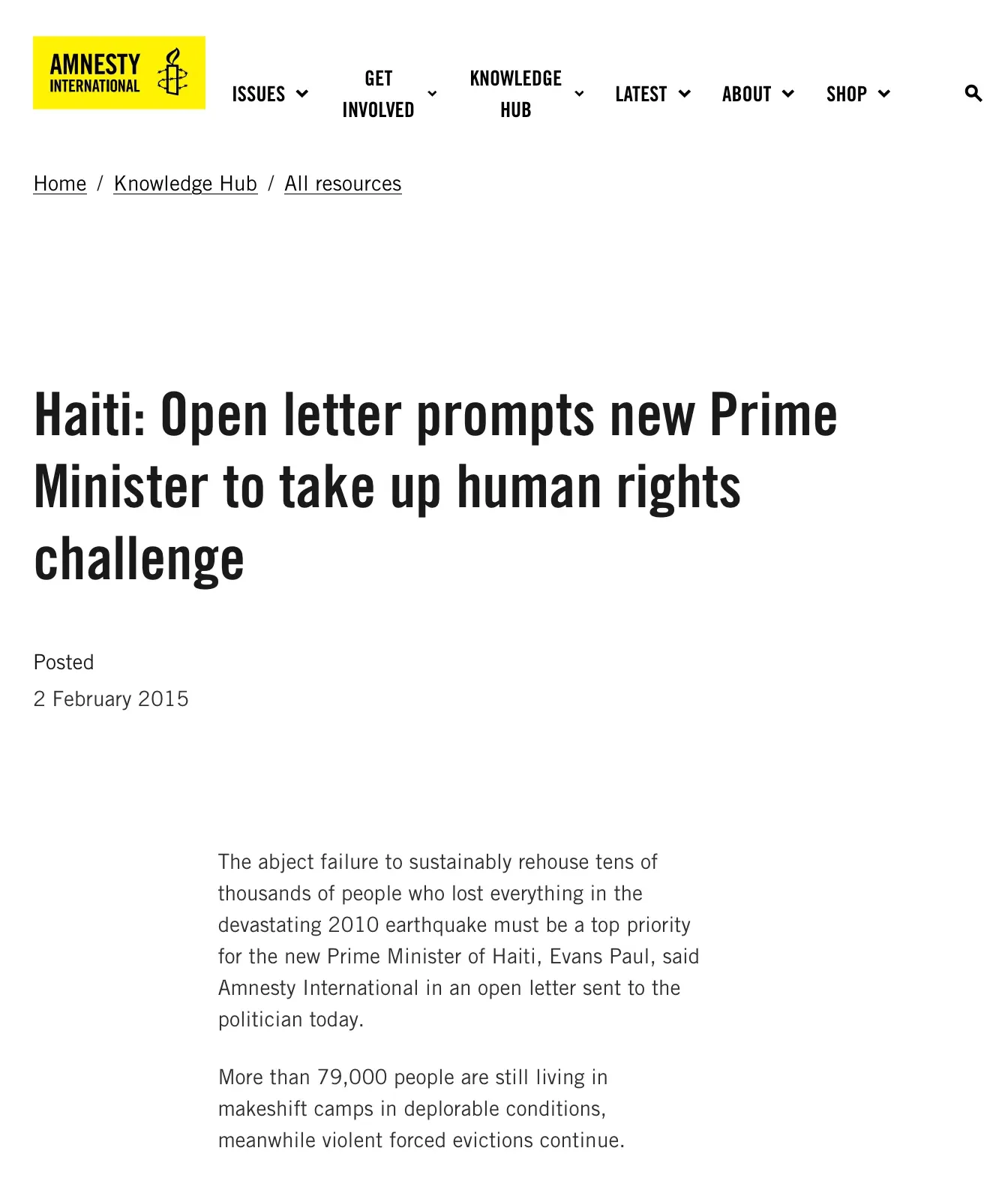
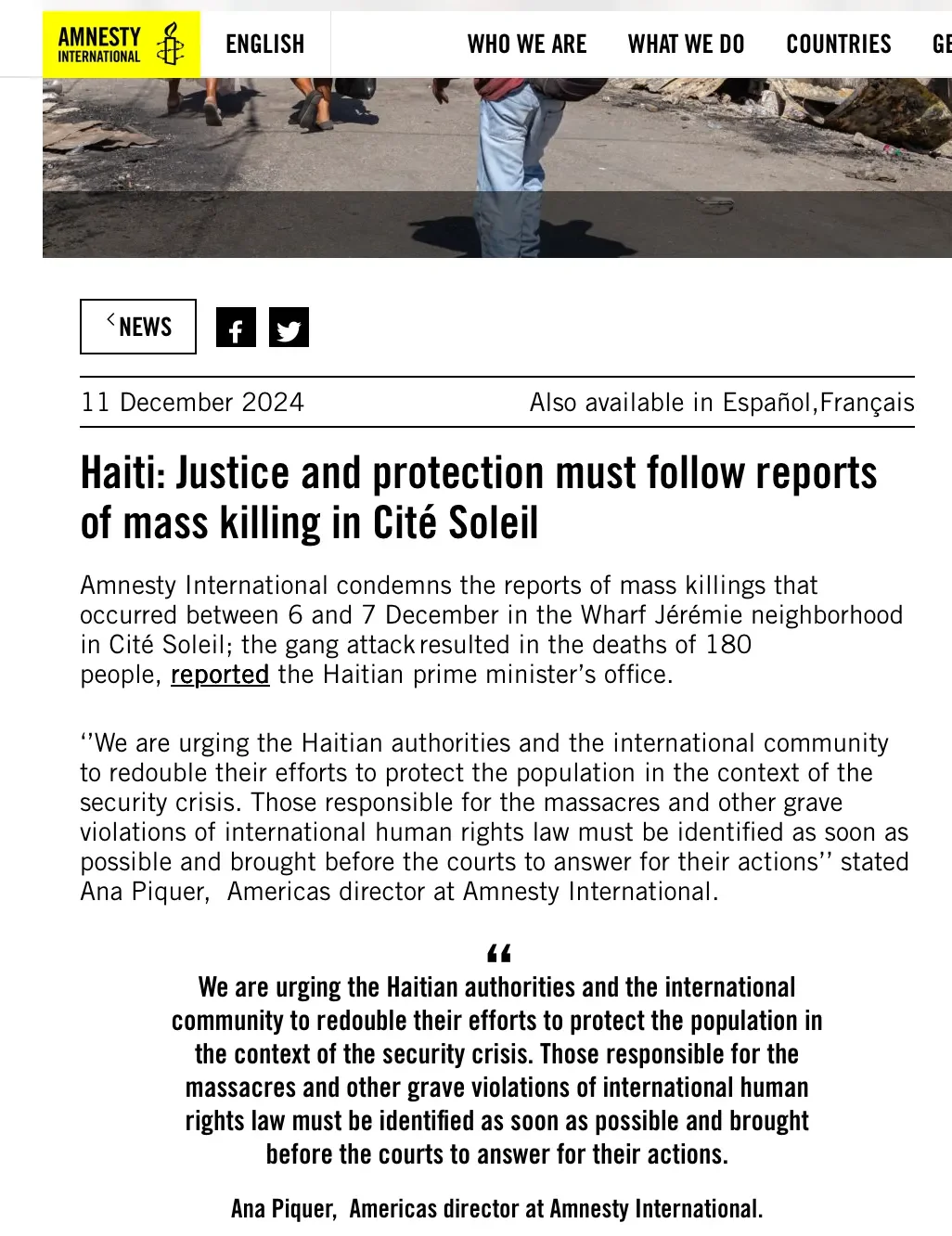
Amnesty International and other human rights organizations have spent years pressing Haitian authorities to protect the population and to confront the gangs more forcefully. They have documented how gangs recruit, rape, and kill Haitian children, and they have insisted that every innocent civilian deserves dignity. So when we say “fuck those organizations,” what are we really rejecting? If it is the principle that innocent people deserve dignity, then what exactly are we fighting to save?
Amnesty’s request was not only reasonable, but also necessary, because both governments have kept the public in the dark. More importantly, as citizens, we should all ask what they are agreeing to in our name. While many believe there was an agreement for Bukele’s surge, we found out that Ayiti’s Council of Ministers approved an agreement only on November 17, weeks after Salvadoran troops arrived, and its terms remain hidden.
Who Counts as an Enabler?
The young lady’s demand raises an even harder question. What would it mean to kill “everyone who enabled” the gangs? Nearly half of Haitians live on less than $3 a day. Imagine two parents earning that much, raising two children in a home they spent years building. When gangs take over their neighborhood, they can either abandon everything and join the 1.5 million displaced Haitians, or stay and survive under gang rule.
To those who want every enabler killed, staying makes them suspects. Does it also make them accomplices who deserve to die? A license to kill every perceived enabler is a license to kill innocent Haitians.
The United Nations reports that drone strikes and helicopter fire have killed at least 87 civilians, including 21 children, since March 2025. In early 2026, security operations, not gangs, caused more than two-thirds of all casualties. In the first week of the Salvadoran offensive, Doctors Without Borders treated 30 people for gunshot and drone wounds.
The gangs grew strong on impunity, and no one defeats impunity by demanding more of it.
Our government and every armed force on our soil have a constitutional duty to protect these Haitians. What separates soldiers from gangs is that soldiers follow rules of engagement, which exist to stop armed forces from treating every poor neighborhood as enemy territory and every resident as an enabler.
When Desperation Becomes Consent
Haiti’s Latest Folk Hero? The Leader of Another Country....
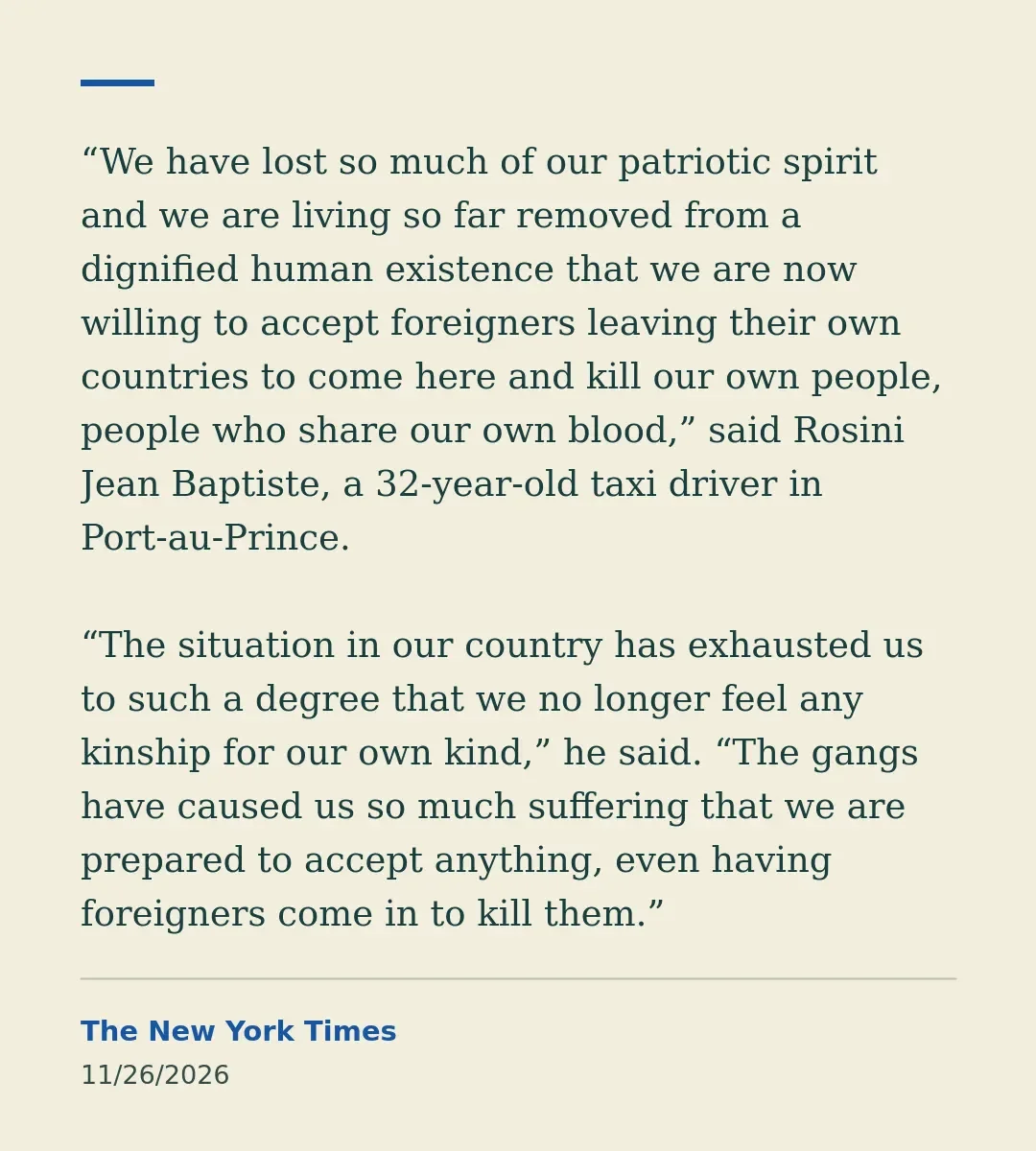
Jean Baptiste’s words in this NY Times article are not a defense of the gangs but a confession that suffering has worn away our sense of kinship, and a warning that desperation can become consent.
In this geopolitical game, Bukele, with Trump’s apparent blessing, stands to gain from his intervention in Ayiti in three ways:
Politically, a victory in Ayiti would make Bukele the face of a law-and-order agenda that the right-wing hopes to export across the region.
Economically, El Salvador is marketing that model, prisons included, across the region. Costa Rica recently opened a mega-prison built with Salvadoran cooperation, and at least 16 similar projects have been proposed in 10 Latin American countries. Our government has reportedly agreed to let a Salvadoran firm and a Haitian firm build three prisons here, though the terms remain undisclosed.
Militarily, Salvadoran forces have deployed rifle-mounted robot dogs into combat zones for the first time. As we clamor for safety, we are turning Ayiti into a testing ground for new models of urban warfare.
No Parades, No Funds for Our Heroes
I believe our willingness to accept civilian deaths stems from something older, in some ways a lack of care for our own. This is not new; we have accepted fellow Haitians being seen as others. We call them kokorat and Restavèk, and many of those who make up the gangs were once the children we scorned and excluded.
On November 17, the eve of Vertières, thousands marched in Port-au-Prince and Brooklyn to thank Bukele, and calls to raise money for Salvadoran soldiers spread online.
We cheer Bukele yet seem unable, if not unwilling, to learn from him.
Whatever one thinks of his methods, he stands by those who fight for his people and soldiers. When four of his soldiers went missing, he sent 2,500 troops to bring them home. When three others died handling explosives, he created a $1 million fund for their families within two days.
https://web.rnddh.org/wp-content/uploads/2026/06/5-Rap-PNH-12Juin2026.ENG_.pdf
In contrast, our own fallen officers receive no such honor or care, and that is our collective shame. The human rights organization, RNDDH, recorded 35 police officers killed between June 2025 and June 2026. The bodies of five officers killed in Village de Dieu in 2021, thirty minutes from the National Palace, were never recovered. In July 2025, gunmen in Liancourt were filmed dragging officers’ bodies beside a burning armored vehicle. To this day, we have not created a fund to support their families, yet our diaspora organizations and churches have mobilized to show support for Bukele.
On November 13, Souf pou Ayiti, a coalition coordinated by Pastor Gregory Toussaint’s Tabernacle of Glory, launched a petition supporting Bukele’s intervention. It gathered more than 9,000 signatures in about five hours. Addressed in part to Amnesty, it asks the organization to care for victims and to demand respect for human rights from all, which is precisely what Amnesty has done for years. I have supported Pastor Toussaint in the past because I saw him as a leader, but here he chose to follow the crowd rather than lead the flock. His campaign is attempting to rally the faithful around Proverbs 31:8, a call to speak for those who cannot speak for themselves. The widows and children of our fallen officers fit that description, yet he is not speaking up for them. When we value foreign soldiers above our own people, we are living out two centuries of white-supremacist education, and we seem to hate our own reflection.
Forgetting Has a Cost
Our silence on the Salvadoran agreement also exposes a contradiction, since many of us who dismiss questions about it still demand that our government publish its contract with Erik Prince’s Vectus Global, whose drone strikes the UN links to dozens of civilian deaths.
We have paid a steep price for foreign impunity, but our memory is short, and we seem destined to repeat the same mistakes. On July 6, 2005, about 400 UN troops under Brazilian command, backed by armored vehicles and helicopters, raided Cité Soleil to capture a gang leader. According to the UN’s own after-action report, they fired more than 22,000 rounds into a neighborhood of flimsy homes. The UN said it did not target civilians, yet witnesses described dozens killed or wounded, including children and infants, with some estimates reaching 60. Additionally, it took six years for the UN to acknowledge its role in the cholera epidemic that killed nearly 10,000 Haitians, and justice has been just as elusive for the underage girls who became pregnant after being sexually exploited by peacekeepers.
If accountability has been this hard to win when the rules were public, what can we expect from a hidden deal that our unelected leaders have yet to explain?
Beyond being illegitimate and incompetent, the current de facto administration commands little public trust, making transparency even more urgent. As Amnesty has urged, it must publish the agreements, including its rules of engagement and civilian safeguards, as well as the CECOT deal. I trust that the young woman in the video wants the gangs defeated, as do most Haitians. Still, we must defeat them without losing our humanity, and that begins with loving ourselves and one another enough to believe that every innocent Haitian life is worth protecting.