

We Demand Accountability From FIFA, But We Cozy Up to the De Facto Leaders Fleecing Us
This is a difficult reflection to write following Haiti’s 3-0 loss to Brazil, a match where the Grenadiers struggled to find their footing against one of the world’s most accomplished football nations. Yet, this single result should not overshadow what the team ultimately achieved. By qualifying for the World Cup, Haiti ended a fifty-two-year absence from football’s biggest stage and gave Haitians everywhere a profound reason to celebrate. That pride is entirely earned and belongs to all of us.
Regardless of what happens in the final group match against Morocco, this tournament has already illuminated something vital. We have seen proof that Haitians can accomplish extraordinary things when talent, commitment, and collective effort converge. However, we must also acknowledge that the roster that has carried the national team this far was built almost entirely by Haitians Andeyò. These are players developed in clubs across Europe and North America, with only one athlete still based in Haiti.
This reflects a familiar reality in which Haitians living abroad provide what the homeland currently struggles to produce on its own. Given how Haitians Andeyò are treated, I believe this is important to say.
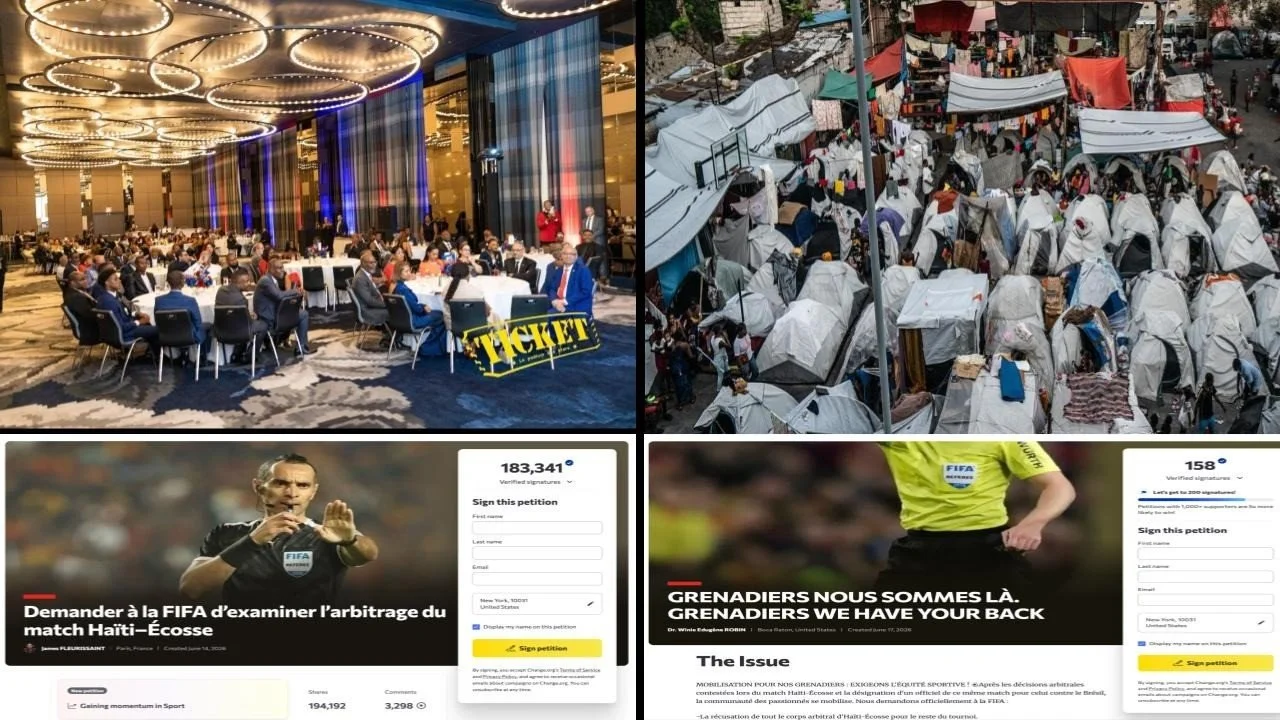
Haiti’s opening match against Scotland did more than frustrate fans, it revealed our remarkable capacity to organize and raise our voices. Two penalty appeals were ignored, and a dangerous challenge that many believed deserved a red card was shown only a yellow. Former FIFA referee Keith Hackett publicly stated that Haiti had grounds for complaint after a missed handball call. The response was immediate. One petition alone gathered 183,341 signatures, and it was not the only one. This swift mobilization forces us to ask a difficult question. Why do we so readily reserve this fierce energy for distant institutions, while the local “leaders” who are directly harming the people receive comparatively less, if any, of our collective resistance?
Breaking Bread With the Fleecers
The stark contrast is undeniable. While Haitians and friends of Haiti organized against FIFA, de facto Prime Minister Fils-Aimé took a privately leased jet to attend World Cup events in Boston and Philadelphia, accompanied by a delegation of de facto ministers. According to Radio Métronome, the Haitian consulate funded the trip, allowing ministers to collect their usual $700 per diem. The prime minister’s rate is $20,000, meaning the state disbursed $200,000 for his ten-day excursion. Given the severe crisis at home, his physical presence was not essential, especially when Haiti’s ambassador could have represented the nation.
To add insult to injury, they attended a consulate-hosted reception at the W Hotel in Philadelphia themed “Entre Héritage et Passion.” In a photograph from that event published by Ticket Magazine, I recognized faces of a number of people I had considered progressive activists, advocates, and media figures who often discuss Haiti’s struggles and demand accountability. Yet there they were, happily breaking bread with those ministers at the public’s expense. Their presence lent their personal credibility to a delegation that was openly exploiting the public in the most cynical way.
While They Feast, the People Rot in Tents
As these unelected officials and their guests mingled in that beautiful Philadelphia ballroom, nearly 1.5 million Haitians lived in displacement camps and makeshift tents. According to the International Organization for Migration, they are surviving in unsafe, unhygienic conditions that no human being should endure. This humanitarian catastrophe stems directly from leaders prioritizing private jets, generous per diems, and luxurious receptions, all while waiting for international organizations to fulfill the duties that belong to the Haitian state.
Still, many of the people in that ballroom, if asked, would be quick to claim that the UN and international NGOs are misappropriating funds rather than aiding people in need. Most Haitians are certainly eager to criticize foreign governments for meddling in Haiti’s affairs, and much of that criticism is warranted. However, when those same officials host publicly funded galas, those claiming to represent the people often bend the knee. They value access to the powerful more than demanding justice.
I will always disagree with and call out fellow advocates and the many activists who rightly point out foreign influences in our struggles but grow hesitant or complicit when given the chance to confront the perpetrators directly.
The true lesson of this World Cup isn’t just about losing on the field, but recognizing that we have agency, a voice, and the power for collective action, as evidenced by the petitions. What we lack is the will to hold our leaders accountable. Once the tournament ends, the camps will remain worse, children will remain vulnerable, and it will be especially hard for young girls and boys who face sexual assault and exploitation. Yet, de facto prime minister Fils-Aime will continue to rule as if he were a king. He will claim that the Haitian community abroad supports him, and he will have the receipts to back it up.
We showed that we can rally when a referee makes a wrong call. The deep shame is that we can’t do the same for our own people. Instead, we continue to cozy up with those responsible for fleecing the country and the suffering of its people.