

America’s Commitment to Overcoming Its Original Sin Is Being Tested
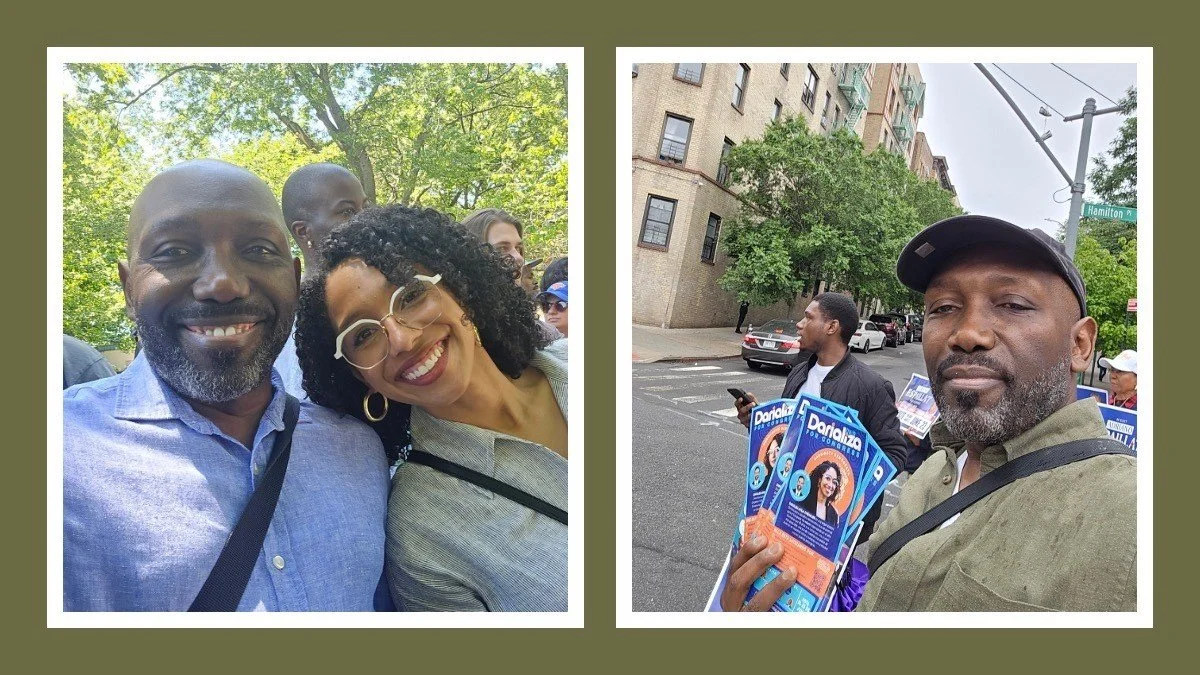
This week, I experienced both hope and disappointment within the span of just a few days.
I was one of hundreds who volunteered for Darializa “Dari” Avila Chevalier, who defeated Adriano Espaillat, one of New York’s most entrenched political figures. The race turned ugly in its final days as supporters of Espaillat sought to weaponize anti-Haitian prejudice within parts of the Dominican community, presenting Dari’s perceived Haitian ancestry, her French/Haitian-sounding last name, as a disqualifying liability. In the election booth, our neighbors rejected that appeal and voted for Dari, whom they believed would best represent them. A NY Times post-election analysis found that 40% of majority-Hispanic precincts supported Dari despite those efforts. It gave me hope to see that organized people overcame systemic prejudice and that democracy prevailed, despite the significant backing and spending from the corporate faction of the Democratic Party in support of Espaillat.
Sadly, just days later, the Supreme Court offered a sobering reminder that another vision of America is also fighting to define the country’s future. In a 6-3 ruling along ideological lines, the Court cleared the way for the Trump administration to end Temporary Protected Status for approximately 350,000 Haitians and 6,000 Syrians, exposing hundreds of thousands of families to potential deportation. The Court also permitted Louisiana to eliminate a second majority-Black congressional district in the middle of an active election cycle, a ruling that Justice Elena Kagan warned in dissent had rendered the Voting Rights Act “all but a dead letter.”
Whatever legal reasoning the majority offered, the practical effect is unambiguous: Black political representation is being deliberately reduced.
As an immigrant, I do not experience moments like this as distant legal debates. I experience them as reminders that belonging in this country is always conditional, always negotiated, sometimes in the voting booth and sometimes in courtrooms far removed from the communities most affected.
The Patterns Are Impossible to Ignore
The connection between these two events is not accidental, and Haitians should be among the first to recognize it. We have watched exclusion consume our own nation. Haiti did not decline because it lacked capable people or material resources. It was weakened by generations of leaders who concentrated power, excluded large portions of the population from meaningful participation, and treated citizenship as a conditional privilege rather than a guaranteed right. Once exclusion became the organizing principle of public life, institutions gradually lost the public trust they needed to function. The parallel to what is unfolding in the United States is not a rhetorical flourish. It is an analytical observation grounded in lived history.
The language now surrounding immigration in America follows a pattern Haitians understand from the inside.
Dehumanization rarely precedes exclusion by much.
Societies that seek to strip groups of legal protection rarely begin by changing laws. They begin by persuading the public that certain groups deserve less dignity, less empathy, and less constitutional standing. Haitians have become one of the most visible targets in this political moment because we stand at the intersection of race, immigration, and national origin simultaneously.
The Cost of Showing Up Separately
The question before us is not simply what the government will do next. It is how we, as a community, will respond, and whether that response will be adequate to the moment.
The Haitian community’s response has too often followed a predictable and exhausting pattern: another organization is created, another statement is issued, and then we retreat into our respective corners until the next crisis demands the same performance. Our greatest weakness has never been the absence of committed people. It has been the absence of a trusted table around which those committed people can sit together, argue honestly, and commit to something beyond the next news cycle. Fragmentation has become one of our most reliable political liabilities.
Our civic organizations, faith institutions, professional associations, and business leaders are not failing for lack of commitment.
Our civic organizations are failing because they refuse to coordinate.
Each guards its institutional turf while the ground shifts beneath all of us, and that fragmentation is not a side effect of our weakness. It is a condition our opponents rely on. The Romans called it divide et impera, divide and rule, and it has never stopped working because those targeted so often do the dividing themselves. Closing that gap requires that collective interest take precedence over individual visibility, and that institutions like the National Haitian American Elected Officials Network (NHAEON) finally fulfill the purpose for which they were built: bringing leaders with different missions to a shared table, forging a common agenda, and speaking with one voice. That function must be activated now, not deferred until the crisis feels more acute.
Dari won because ordinary people organized, showed up in the rain, and refused to accept the notion that their voices did not matter. I believe that spirit lives within the Haitian community, and building the organized infrastructure that enables it to develop and sustain leaders worthy of it is the work I am committed to.
We are watching in real time as the United States decides how far it is willing to go in defining who is fully human and who is not fully protected by the law. As Haitians, we should never be confused about where that logic leads, because we have already seen its consequences, even as those who perpetrated the exclusion now attempt to position themselves as saviors. The question before us is no longer whether we understand the moment, but whether we are willing to act as if it is already here.
As Haitians, we have already witnessed the damage exclusion can inflict on a nation. As Haitian Americans, we should therefore be the first community to recognize these warning signs and the first to organize in response. This is the fight of our generation, and the moment calls for coordination. It asks whether we are willing to turn shared concern into shared capacity and shared capacity into shared power.
“It is better to die on your feet than to live on your knees.” – Emiliano Zapata, Mexican Revolutionary leader