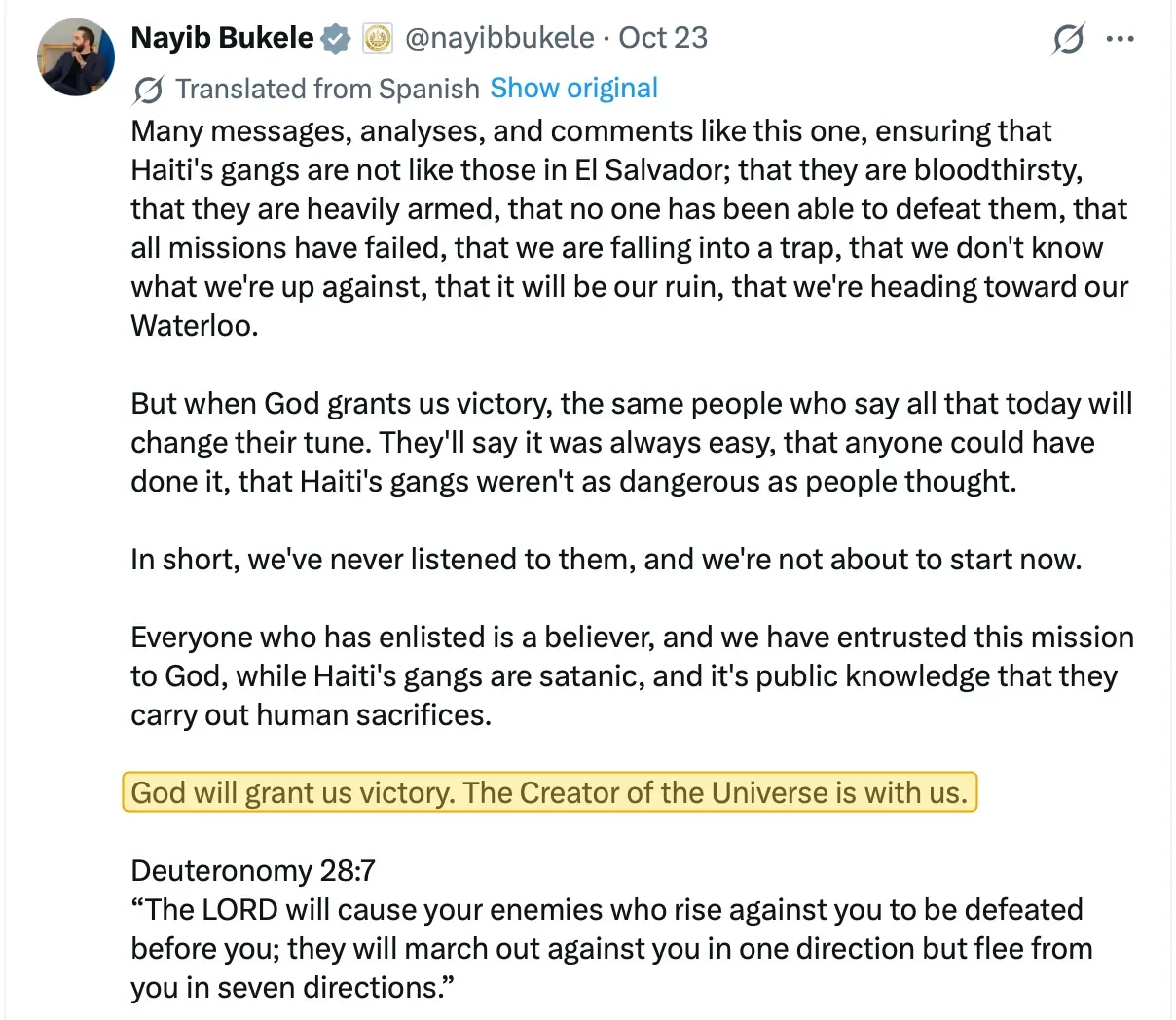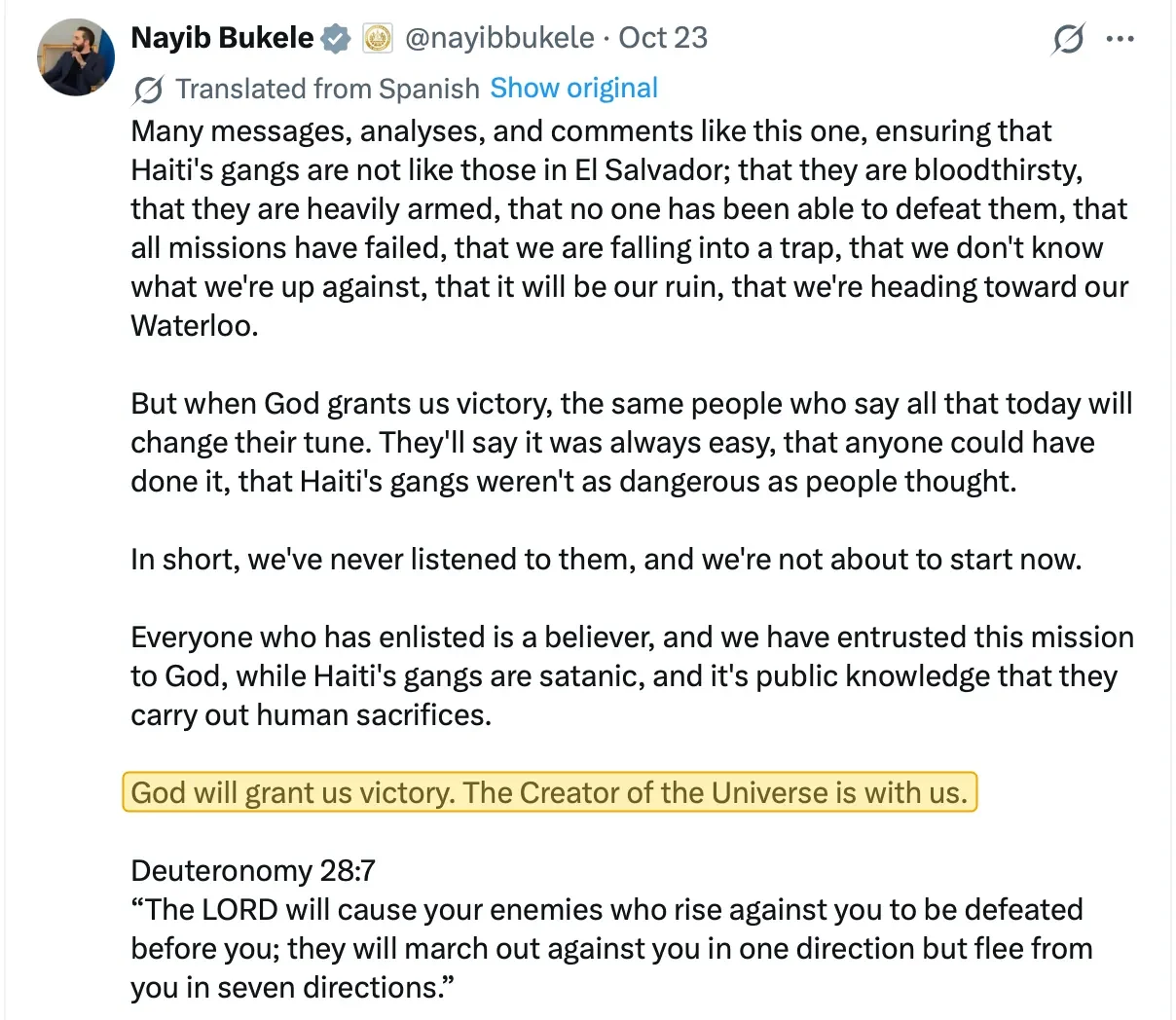
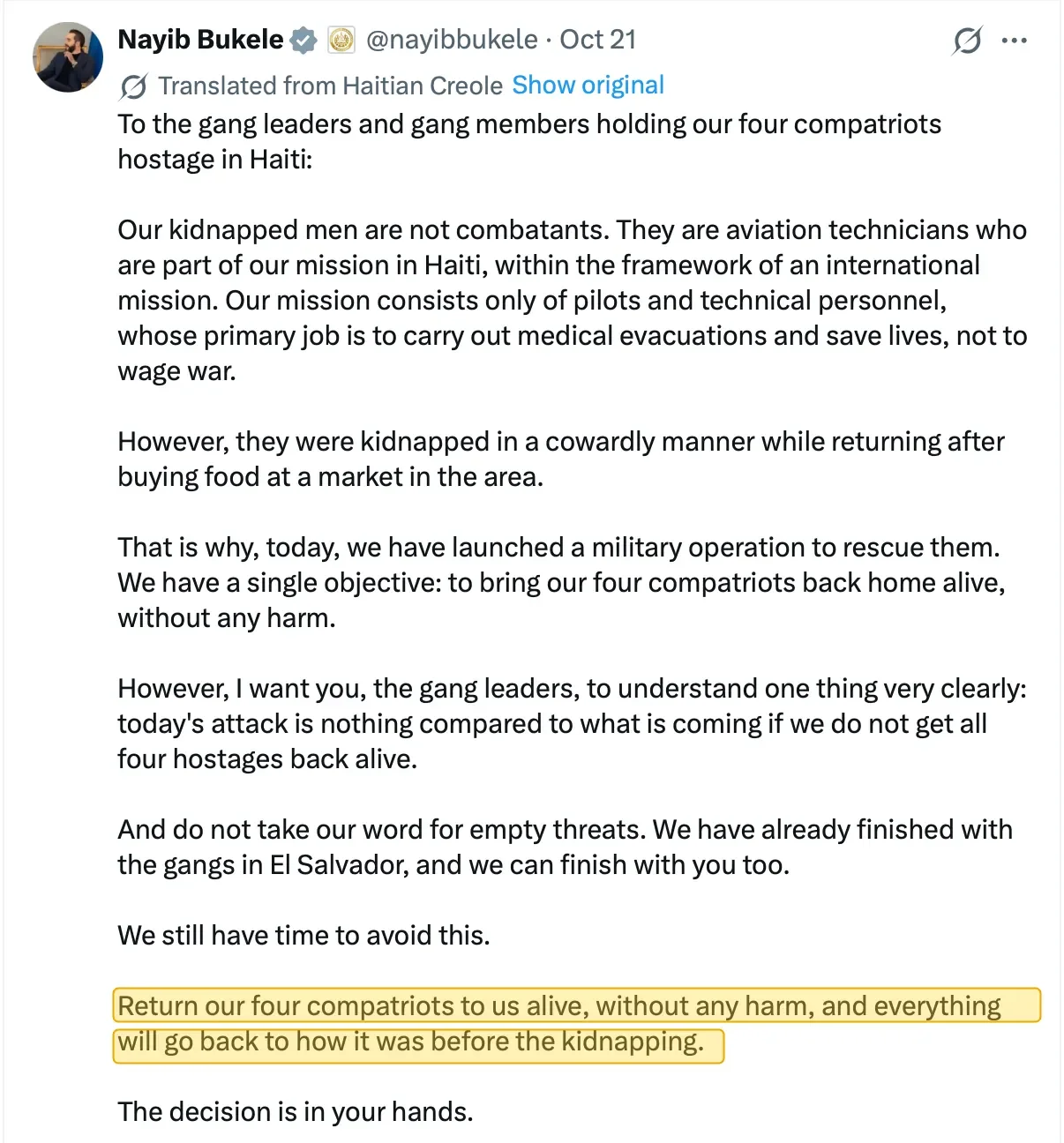
On October 27, Haitian journalist Cyrus Sibert declared that God had chosen Salvadoran President Nayib Bukele to punish Ayiti’s gangs. Nine days earlier, gangs ambushed four Salvadoran aviation technicians serving with the UN-authorized Gang Suppression Force (GSF) in Santo, Croix-des-Bouquets. Bukele responded with an ultimatum: return the four men alive, and “everything will go back to how it was before the kidnapping.” El Salvador has since confirmed deploying more than 2,000 soldiers, roughly the size of the entire GSF.
I understand the hope behind Sibert’s enthusiasm. When people are massacred, raped, and displaced, any promise of decisive force can feel like an answer to prayer. Most Haitians share that hope.
I agree with Sibert that Haiti’s political class has failed catastrophically. He describes a state held hostage by corrupt politicians, judges, police officers, and businessmen, and warns that without honest leadership, this intervention could leave Ayiti worse off. He also accuses the Dominican Republic of arming gangs and dismisses past UN missions as humanitarian tourism.
How, then, does his clear-eyed analysis lead him to believe that God sent Bukele to fight for Ayiti? By Sibert’s own account, Bukele intervened “pour venger ses ressortissants,” to avenge his nationals. His mission ends with either the return of four Salvadorans or vengeance against Haitians, and neither will liberate Ayiti.
The broader question is whether we are conflating a foreign president’s military objectives with a lasting solution to our political and security crisis.
Savior and Villain, the Haitian Contradiction
An Instagram video by an influencer who admits knowing little about Ayiti circulated widely across Haitian social media and in my WhatsApp groups. She correctly noted that UN investigators traced gang ammunition to Dominican stockpiles. A June 2026 Harvard Law School report also found that 78 percent of traced firearms recovered in Haiti were purchased in Florida.
Yet she omitted evidence implicating Haitians, including weapons and ammunition diverted from our National Police and the arrest of officers for supplying gangs. Her video spread because we embrace stories that confirm what we already believe, even when they let our own people off the hook.
We have consistently opposed foreign intervention, often for good reason. UN peacekeepers brought cholera, killing nearly 10,000 Haitians, and the organization took six years to acknowledge its role. Sixteen years later, some of us celebrate Bukele as God’s chosen fighter, welcoming Salvadoran soldiers who may operate independently, without asking who will answer for the harm they cause.
We are caught in a contradiction. We reject foreign intervention, yet we are welcoming another army to rescue us. We demand sovereignty while expecting others to fight for our freedom.
Ayiti Is Leaderless and Rudderless
I do not make predictions, but three outcomes seem possible, with two more plausible than the third.
First, Salvadoran forces could launch an overwhelming assault, killing gang members and innocent Haitians alike, before withdrawing. Second, they could wage a prolonged campaign, costing more Haitian lives, only to leave the same political system intact. Third, they could weaken the gangs enough for Haitian leaders to restore security and establish lasting stability. Our recent history gives us little reason to believe our leaders will seize that opportunity.
During the crusader massacre at Béziers in 1209, soldiers reportedly asked how to distinguish heretics from the faithful. The response was chilling: “Kill them all. God will know his own.” In Ayiti, where gangs and families live side by side, I wonder who will decide which Haitians belong to Satan and which deserve to live. And who gave a foreign president the authority to make that decision?
Bukele’s religious framing heightens the risk of innocent civilians being killed.
He called Haiti’s gangs “satanic,” accused them of human sacrifices, and declared that “God will grant us victory.” At home, his government has jailed more than 90,000 people under emergency rule, with at least 470 dying in custody. A military shaped by that record, convinced it is fighting Satan, and potentially operating outside the GSF’s rules of engagement raises serious questions about restraint and accountability.
The return to “normal” is equally troubling. If Bukele defeats the gangs, who governs the territory afterward? What prevents the same political and economic networks from rebuilding the gangs? Without credible Haitian leadership, no one does. Those who financed and supported the gangs are preparing for elections and the same forces that brought us to this point will come back. The foreign forces will go back home victorious; we will bury our dead; and the system that produced the gangs endures.
In an October 29 tweet, Bukele reminded us of El Salvador’s suffering and wrote that, “no one came to help us, and those who did come didn’t have good intentions in their hearts.” Salvadorans had to confront their own crisis. The biblical verse calls on the people to humble themselves and change their ways so their land can heal. It does not tell them to wait for a foreign army.
We know that Bukele answers to Salvadorans, and Dominican President Luis Abinader answers to Dominicans. Who answers to Haitians?
No one is coming to save us. I believe that the most dangerous thing we can do is continue believing someone will.