

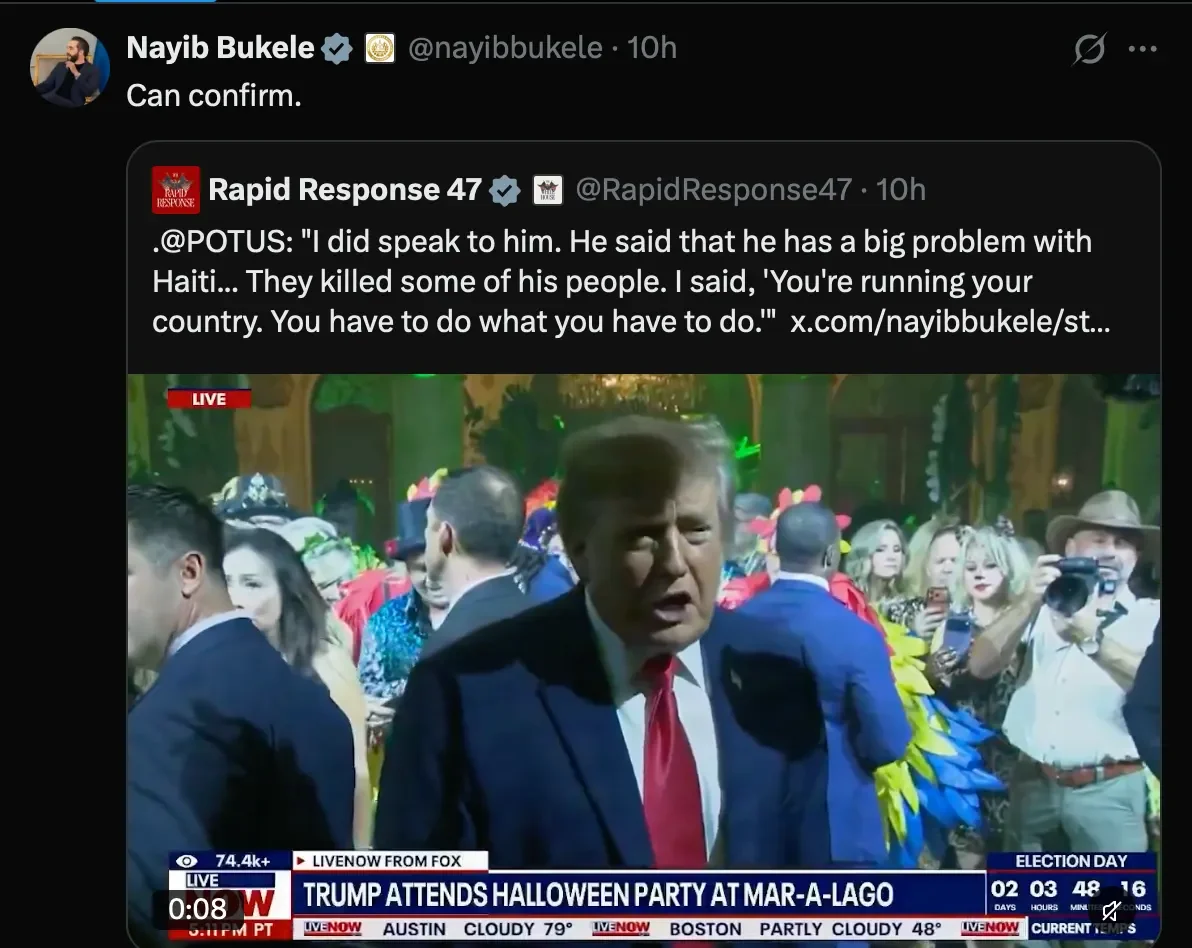
“You’re running your country. You have to do what you have to do.” President Donald Trump said those words after Salvadoran President Nayib Bukele told him that gangs had killed his four soldiers in Ayiti. An American president told a foreign leader he could do whatever he wanted on Haitian soil. If we are ok with Bukele, then we are gonna have to be ok with Erik Prince.
The UN Security Council created the Gang Suppression Force in September 2025 through Resolution 2793, yet El Salvador has contributed only 140 personnel to it. If Bukele cared so much about Ayiti, he could have committed more. After four Salvadorans disappeared and we’ve since learned from Trump that they’ve been killed, he sent a surge of 2,500 troops.
President Bukele could have placed them in the GSF and remained within international law. Instead, he secured Trump’s blessing to run the mission himself, making it an invasion.
That he could do so shows that Ayiti’s de facto government has no real leaders. Worse, in the middle of an electoral campaign, not one candidate who wants to lead Ayiti has taken a position, for or against, on the most consequential event.
I received many comments on my last article about this deployment, which I will categorize into two buckets. The first is that since I don’t live in Ayiti, I can’t understand why Haitians under gang rule would welcome foreign soldiers. The other is that one can’t make an omelet without breaking eggs, and since the gangs are killing innocent people anyway, this is justified.
They are right that I do not live in Ayiti. Those in the line of fire bear the heaviest burden, and their voices should carry the most weight. Respecting their pain does not mean the rest of us should stop asking questions. Since many Haitians have long said Port-au-Prince is not Ayiti, the “you are not in the line of fire” argument disqualifies not only those living abroad but also Haitians in Les Cayes, Cap-Haïtien, or Jérémie. They, too, should not have an opinion on this issue, which affects the nation.
Until Trump, who has no filter, told the tale, Bukele said he only wanted to rescue his soldiers. He understood that saying “we want revenge” would not be good communication.
Mr. Bukele is like Trump, who will piss on you and try to convince you it is warm Caribbean rain.
I also wonder what the reaction would have been if President Abinader had sent troops into Ayiti to “rescue” Dominican soldiers. I am pretty confident that very few Haitians would have accepted that. We have an obligation to demand accountability, whether it is the Dominicans, the US, or Salvador. We must know who authorized this operation, and what rules of engagement will guide the Salvadoran soldiers.
These questions matter because the eggs in that omelet are Haitian lives.
For a family in the crossfire, a soldier’s bullet kills as surely as a gang member’s. We must also admit that we are handing over our sovereignty, and Venezuela shows where that can lead. The Pentagon now holds a 35 percent stake in a venture with 100-year rights to 17 Venezuelan oil fields. I do not know whether this operation will weaken or destroy the gangs, but we must ask whether we are trading a brief calm for a longer dependence.
Asking these questions is not indifference to the terror people face every day.
It is how we ensure the blood spilled counts for something and does not become one more sacrifice for those who are most vulnerable. Our expectations cannot be so low that we refuse to ask what we are getting in return for the lives of our compatriots.
For too long, geography, class, and closeness to power have decided whose voice counts in Ayiti. People treated as moun andeyò, whether in the provinces or abroad, have been left out of the country’s decisions. Speaking up about this mission is every Haitian’s right and responsibility, wherever we live.
Those who would give up essential Liberty, to purchase a little temporary Safety, deserve neither Liberty nor Safety"— Benjamin Franklin.