

The colonial hand wears a Haitian glove
When a foreign pathogen enters the human body, the immune system mobilizes every available resource toward a coordinated response, because survival depends on correctly identifying what belongs to the body and what does not. Some pathogens complicate this through molecular mimicry, coating themselves with signals that resemble the body’s own cells. In those cases, strength is not enough. Recognition must come first.
In Haitian society, there are actors who present themselves as part of the national body while actively working to weaken it. The central challenge is our persistent difficulty in identifying what undermines the social fabric, and that difficulty has eroded our capacity for collective defense.
The Misdirection Keeps the Elite Above the Fray
In a previous article, I wrote about a BBC Africa Eye documentary about Operation Dudula in South Africa. A vivid moment remains with me: an elderly Black woman, speaking calmly yet strongly, expressed hatred for “foreigners” and called for them to be burned alive. This was not an isolated act of rage. It illustrates how pain, when directed in a certain way, can detach from its original cause and be aimed at the easiest targets—similar to referred pain in medicine, where the body senses pain in one area but the injury is actually elsewhere. The community’s anger stems from real issues like unemployment and economic hardship, but it’s no accident that they blame the wrong culprits. More than three decades after apartheid officially ended, Afrikaner families still control much of South Africa’s land, mining resources, and financial assets, while the political establishment has deliberately kept this structural inequality hidden, diverting public anger toward foreign workers instead of confronting the entrenched power structures that benefit the few.
We can observe the same playbook being used in Haiti.
A small elite retains structural command over the Haitian economy while the majority can barely survive. For example, Gilbert Bigio is described as the richest man “in Haiti.” He chairs GB Group, a conglomerate spanning steel, energy, consumer goods, logistics, and port infrastructure, with Pandora Papers records revealing that one of his family trusts held investments in Haiti’s fuel industry. Sherif Abdallah, an insurance and banking magnate of Egyptian descent who emigrated to Haiti in 1981, built his influence across aviation, real estate, and finance while serving as a close political ally of the late President Jovenel Moïse. In December 2022, Canada sanctioned both men, along with Reynold Deeb, accusing them of using their elite status to protect and enable the illegal activities of armed criminal gangs through money laundering and other acts of corruption. Together, according to the ICIJ investigation, Bigio and Abdallah owned or held interests in at least 20 companies and trusts registered in some of the world’s most secretive tax havens. These networks of wealth and influence remain operational while public attention is consumed by internal political conflict.
From Pont-Rouge to Pétion-Ville: betrayal and exclusion remain the only constants
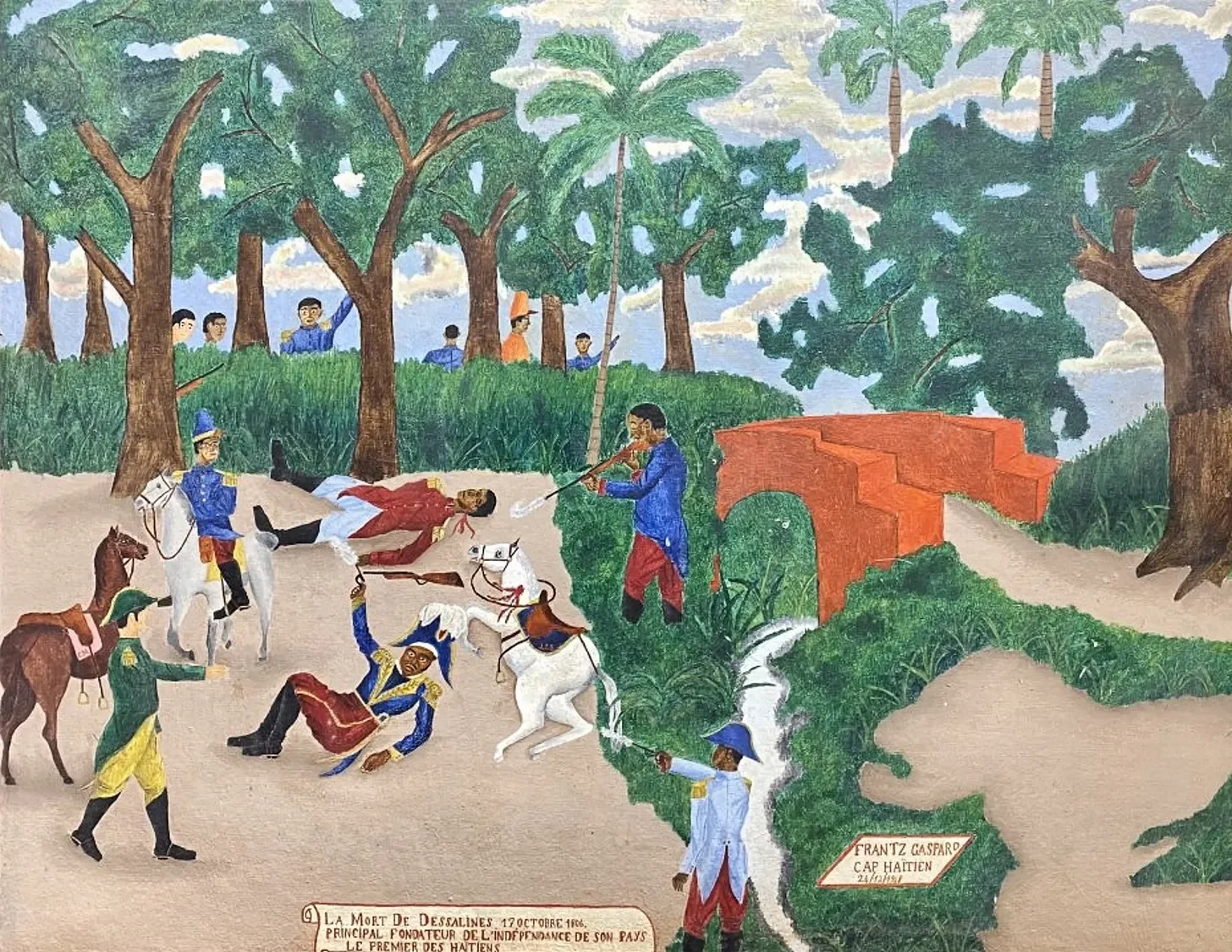
On October 17, 1806, Jean-Jacques Dessalines was brutally assassinated by a coalition of former allies and rivals, most notably Alexandre Pétion and Henri Christophe. That moment matters not for the horrific way Haiti’s founder met his end, but because it revealed a governing logic that has endured ever since. Faced with a choice between broader inclusion and the preservation of power, these influential Haitians chose exclusion, and successive generations reproduced some version of that logic.
Fast-forward to 2026. Mr. Alix Didier Fils-Aimé became Haiti’s Prime Minister by a stroke of luck. He was chosen by the Transitional Presidential Council and, by all accounts, elevated to a position for which he was wholly unprepared. He now governs alone, and as such, he had a real opportunity to expand the political rights of Haitians Andeyò. Instead, like those who came before him, he has chosen to further restrict our ability to participate in Haiti’s civic life. His betrayal of the nation is clear. In March 2026, while Haitians remained displaced by gang violence and unable to move freely across the country, his government spent $18 million to purchase the former Best Western hotel in Pétion-Ville to house the Ministry of Defense, a ministry that has yet to demonstrate it can defend anyone. More revealing still is the government’s decision to contract with the private security firm run by Erik Prince, the founder of Blackwater, to operate inside Haiti. This is the same Erik Prince who, in a podcast interview, declared that it was time for the U.S. to put the imperial hat back on and govern countries across Africa and Latin America because, in his words, they are incapable of governing themselves. A government that subcontracts its sovereignty to a self-declared imperialist while restricting the political rights of its own citizens abroad is not simply incompetent. It has told us exactly where it stands and exactly who it serves. This is the sickness the immune system must learn to identify before it can respond. So my fight cannot be against Mr. Prince. It must start with Mr. Fils-Aimé.
Foreign interference has always been outsourced
I often find myself at odds with fellow advocates who focus excessively on the international community. Washington’s influence on Haitian affairs is real and not in dispute. What concerns me is what happens when that argument becomes the whole of our analysis. Overemphasizing it reduces us to passive objects, always acted upon with little control over our own circumstances. More importantly, this framing primarily benefits the Haitian elite, who profit from the existing system and deploy the foreign interference narrative as a shield against accountability for their own role in maintaining it.
This dynamic was on full display when Prime Minister Fils-Aimé, the man responsible for restoring security in Haiti, was filmed singing alongside protesters demanding exactly that. A leader cannot lament a crisis he is supposed to be solving.
In New York, we call that chutzpah. It is the breathtaking audacity of wronging someone and then expecting their gratitude.
An objective analysis tells us that directly challenging US foreign policy is difficult, and while we must try, doing so without a clear strategy is an exercise in frustration rather than resistance. Washington's influence in Haiti operates through proxies, and Haitians cannot rely on those collaborators to dismantle the system that sustains them. As the late professor and president Leslie Manigat observed in an interview, Haiti's collaborating class has never needed explicit instruction from foreign powers to serve foreign interests. They have internalized the logic of the arrangement so thoroughly that they execute it autonomously, which makes them more, not less, culpable than simple order-takers would be. I have argued before that this pattern of exclusion and the elite’s capture of the state are not accidents but design features of Haitian political life.
If the US and other international actors' intervention is at the root of Haiti's governance crisis, then confronting it begins by challenging and removing the domestic actors through whom that influence is exercised. That is the only strategy with any real chance of changing anything.
The price of complicity is accountability
When you are smaller than your adversary, a frontal fight is rarely the right opening move. The smarter approach is to identify the openings your adversary creates and exploit them. This is why, when external powers, due to their own internal political needs, find it necessary to impose sanctions on their collaborators, as Canada did with Gilbert Bigio, Reynold Deeb, and Sherif Abdallah, they create an opening that we must exploit. We should treat those sanctions as an opportunity to press our own accountability demands further than any foreign government will.
Those of us living abroad have less to lose and more leverage than we often acknowledge, and how we use that leverage is not a matter of personal virtue but of strategic coherence. You cannot simultaneously demand accountability in Haiti and extend legitimacy to those who are blocking it. Every platform we offer to those figures, every conference invitation, every public embrace of an official whose government is actively restricting our political rights, directly undermines the argument we claim to be making. This is not about purity, but we must be coherent in our actions. The Bigios, Abdallahs, and Deebs of Haiti’s economic elite, along with the political figures who enable them, should find no legitimacy in our organizations, our community spaces, or our public platforms.
The immune system either organizes, or the body dies
This moment calls for strategic alignment grounded in mounité, the shared human connection linking Haitians in Andeyò with those in the rural interior, Haitian women who face double exclusion, and young people who have never known stability yet represent Haiti’s future. That alignment requires leaders who understand that inclusion is the only organizing logic for building a durable movement.
Zora Neale Hurston reminded us that not all skin folk are kin folk. The coalition that ambushed Dessalines at Pont-Rouge did not disappear. It survives wherever power is valued more than people, and exclusion remains their strategy for preserving it. Confronting that reality is uncomfortable, but it is where the work begins.
Too many of us claim to want change while maintaining ties to the very actors who benefit from Haiti’s dysfunction. That is not merely a moral contradiction; it is an epic strategic failure. The body politic, like the human body, cannot heal if it misidentifies the source of its injury. It heals when its resources are aligned, its defenses are coordinated, and its attention is directed toward the actual wound.
Haiti’s crisis has endured for more than two centuries because the interests that benefit from it have been organized, disciplined, and clear about their objectives. Exclusion has survived because it has been organized. The question before us is whether inclusion can become organized too.