

The Right to be Haitian
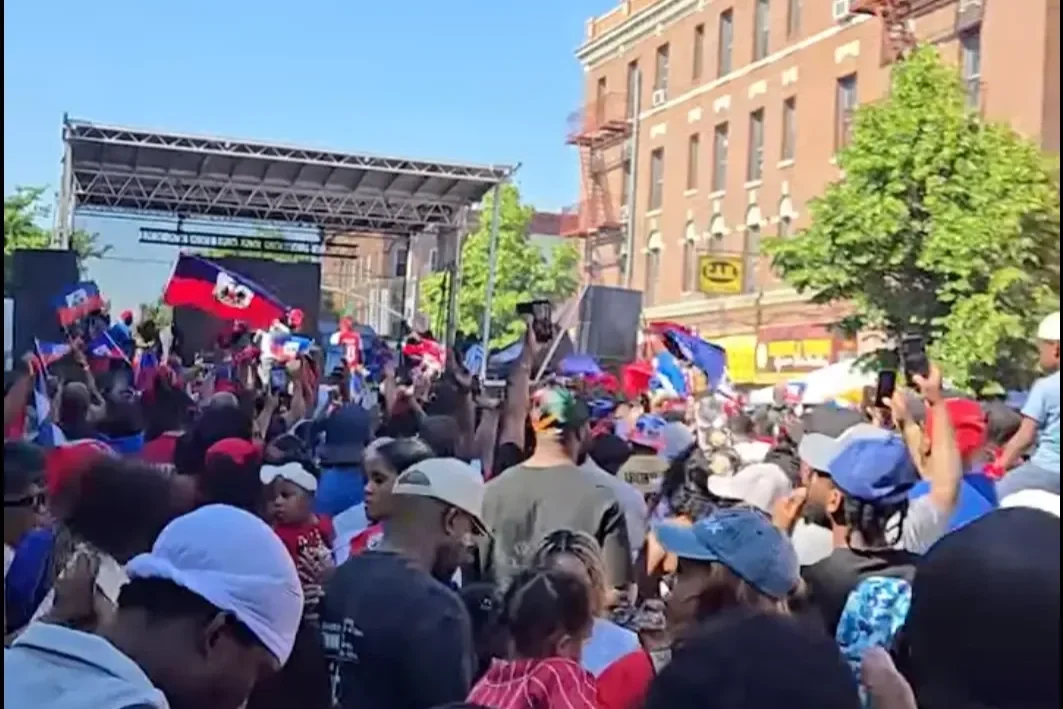
Last Sunday, I attended a Haitian Flag Day celebration in Brooklyn. There were grandmothers proudly waving their flags while parents carried toddlers on their shoulders. Nearby, teenagers gathered in tight circles, singing and dancing. As I watched them, I realized that if I had passed any of them on a Brooklyn street, I would have seen only typical American teenagers. The way they dressed, talked, and the “American” way they carried themselves reflected the country where they were born and raised. But the moment the DJ played a Haitian song, they knew every word and sang along without hesitation. I admit, with some embarrassment, that I did not know some of those lyrics as well as they did.
They were fully American and fully Haitian, carrying both with natural ease and without apology. What struck me most was that this identity had been preserved not by governments or institutions, but by families who refused to let Haiti disappear within their homes.
We are proud to be Haitian Americans, so it is especially hurtful when our homeland, which we support and love, dismisses us as outsiders. Haitian officials often welcome us when the issue is remittances or advocacy for Haiti, but they reclassify us as “others” when political participation is at stake. The word “diaspora” shifts from a geographic term to one that weakens our bond with the country.
As I noted in “Who Counts as Haitian?” earlier this year, this pattern has persisted for many decades and affects the diaspora as well as those living in Haiti’s rural communities. We are the moun andeyò. However, what makes this moment so consequential is that the revised 2026 electoral decree risks formalizing this exclusion into law through articles that ensure our “otherness.” While the proposed decree allows the diaspora to vote in presidential elections, it simultaneously bars us from funding campaigns, running for office, or electing our own representatives to serve in parliament.
Haiti Cannot Afford More Fractures
Researchers who study how states collapse have identified a pattern that recurs across more than a hundred countries: polarization leads to factionalism, factionalism leads to instability, and instability eventually culminates in either autocracy or violent collapse. Haiti does not need political scientists to explain this pattern. We have lived it for generations.
Many observers still believe Haiti’s suffering will eventually produce a popular uprising, a moment when citizens, pushed beyond their limits, rise up and demand change. But that expectation misunderstands something fundamental. People usually fight to restore what they once had. Nearly two generations of Haitians have never known a stable country, a functioning government, or reliable public services. There is no shared memory of normalcy to pull them back from the edge.
The anger is real, but the organized resistance needed to transform that anger into change is weakening, not growing.
Years of violence, insecurity, and economic collapse have exhausted the population. What fills that vacuum is not renewal, but the slow drift toward civil war, where no faction is strong enough to govern and none is willing to stop fighting. Haiti never built institutions that convinced citizens the State was worth trusting or defending. In their absence, Haitians turned to what they could rely on: family, church, and themselves. Instability is one of the few constants in Haitian political life.
The diaspora plays a paradoxical role here. Although we have left Haiti, we still support it emotionally and financially. Each year, we send more than four billion dollars in remittances, exceeding all international aid combined and funding essentials like food, education, and healthcare. The diaspora has effectively displaced the government in providing these basic public services. Additionally, since 2011, the government has collected a $1.50 levy on each of those transfers, with no public accounting of how the money has been used.
We are the constituency being taxed by a government that still refuses to fully represent us.
Haiti’s leaders cannot ask millions of Haitians to finance the survival of the nation while denying us the right to help shape its future. Treating the moun andeyò as a threat to be managed rather than a national resource to be integrated only deepens the fracture at the very moment Haiti can least afford it. Haiti’s political class has relied on our fragmentation for decades, and we in the diaspora have too often allowed it. Excluding the diaspora will not protect Haiti’s democracy. Indeed, it will only accelerate its decline.
Three Arguments the Haitian State Cannot Escape
One of my favorite authors, James Baldwin, wrote in The Fire Next Time that the transformation America needed had a price: the unconditional freedom of Black Americans, because the nation’s future was precisely as bright or as dark as theirs. The same truth applies to Haiti. Haiti will not build the democratic state it has never yet achieved while excluding millions of its own people. I believe there are three arguments that make the demand for our political inclusion impossible to dismiss.
First, Haitian identity is rooted in origin, language, memory, ancestry, and shared responsibility, not in a physical address. The teenagers singing at that Flag Day celebration inherited their Haitianess naturally, without government permission, because it is their birthright. Haiti’s own Constitution recognizes that someone can be Haitian by origin even while living outside the country. That identity predates the State, and no decree can revoke it.
Second, the State has already contradicted itself. The draft 2026 decree grants Haitians abroad the right to vote for President, formally recognizing us as members of the Haitian political community. If we are eligible to vote, we are eligible to run for office. If our votes are valid, our financial contributions to candidates are democratic participation, not foreign interference. As I argued in “What to the Diaspora Is the Latest Electoral Decree?”, we cannot be celebrated on April 20th, the International Day of the Diaspora, and treated as outsiders for the remaining 364 days of the year.
Third, Haiti cannot afford to exclude us. With the country teetering on the edge of state collapse, lacking a functioning tax system and stable institutions, it cannot afford to dismiss the community that sustains its economy. The diaspora sends more money annually than all international aid combined. Excluding us is not only unjust. It is a threat to the nation’s survival.
What We Are Specifically Demanding
Our demands are specific, reasonable, and supported by international precedent, and I have been making versions of them for years, most directly in “Anticipating and Seizing the Moment: 6 Key Demands for Haitian Diaspora Inclusion.” Italy, Portugal, and Senegal have each created reserved parliamentary seats for citizens living abroad because migration does not erase citizenship. Haiti must begin that same conversation. A reserved legislative seat for the diaspora is not radical. It is the minimum standard for a country that claims to want our participation.
We should also advocate for a fair process that allows diaspora Haitians to return and run for office. A Haitian who relocates to a new community should be eligible to represent it after one year of residency. The current two-year requirement and the total ban on dual nationals are instruments of exclusion, not measures of capability. On the presidency, the standard should be different. Since it is the highest symbol of national sovereignty, it is reasonable to require that a presidential candidate hold only Haitian nationality at the time of their candidacy.
Finally, we must oppose Article 204, which effectively bars diaspora Haitians from participating in political campaigns. A naturalized Haitian-American who donates to a Haitian candidate is not a foreign agent. She is a citizen investing in her homeland, just as she does every time she sends a remittance that now accounts for roughly 16% of Haiti’s GDP, welcomed without question by the government and every political entity in the country. If the government denies us the right to financially support a candidate, it should apply that same logic consistently and ban remittance transfers entirely. We know it will not, because it cannot afford to.
We Must Also Be Honest With Ourselves
For those of us living in the diaspora, the Haitians andeyò, the time has come to confront our own failures with the same honesty we demand from Haitian politicians.
We tend to see ourselves as the educated class, professionals with access to technology, capital, and networks. Yet if asked who truly represents the diaspora, the uncertainty in the room would reveal how disorganized we are. At best, some of us might mention former deputy Jerry Tardieu, a politician known for voicing concerns about Haitians abroad. Yet Jerry’s legitimacy is anchored in Haiti’s political system. He does not live in the diaspora and holds no mandate from us. The fact that many of us would instinctively point to a traditional Haitian politician when asked who speaks for us says more about this professional class than it does about Jerry. And this is to our collective shame.
While we have influence as individuals, our collective power remains limited and poorly organized.
We have been far too accommodating of officials who did not earn it. Consider the promises made to the diaspora by Prime Minister (PM) Alix Didier Fils-Aimé, or Minister of Haitians Living Abroad (MHAVE) Kathia Verdier, or former PM Claude Joseph, and former MHAVE Minister Dominique Dupuy. Each of them stood before our communities with the language of inclusion and partnership. Not one took a single concrete action that benefited the diaspora, or Haiti, for that matter.
And yet we welcomed them with packed banquet halls and standing ovations, posted their photographs on social media as proof of our access to power, and watched them return home to govern as though we did not exist. Proximity to power is not accountability from power. We have confused the two for too long.
From a realpolitik standpoint, Haitian politicians have little incentive to focus on the diaspora.
Many see us as a liability rather than an asset because we cannot vote, lack organized political influence, and exist largely outside the patronage networks that dominate Haitian politics. This is a rational calculation, even if it reveals something troubling about the condition of Haitian democracy. Still, we must recognize our own role in this dysfunction. As documented in Without Legitimacy, the Diaspora Repeats Haiti’s Original Sin, the diaspora has too often reproduced the same exclusionary patterns we criticize at home: small circles deciding who matters, prestige valued over accountability, and networking substituted for organization.
The political result is predictable. A community that struggles to organize itself will rarely be treated as a serious force by Haitian leaders.
That reality is precisely what the argument in Why Haiti’s Majority Moun Andeyò Needs a Movement points toward: a diaspora civic vote. This would mean organizing secure and transparent regional elections across North America, South America, Europe, and Africa to identify leaders with a legitimate mandate to speak for diaspora communities. We no longer need self-appointed spokespersons or representatives whose authority rests primarily on visibility or personal connections.
A diaspora civic vote would create something we have never fully possessed: leadership with democratic legitimacy and the collective leverage needed to pressure Haitian institutions. It would also compel us to practice internally the democratic values we demand of Haiti itself. We cannot ask the Haitian State to embrace accountability while refusing to build a culture of accountability among ourselves.
The Invitation
The teenagers I watched at Flag Day are not outsiders to the Haitian story. They are its inheritors. The question is not whether they are Haitian enough — that was settled the moment the music started. The question is whether the diaspora is prepared to stop waiting for recognition from Port-au-Prince and begin building the organized power needed to demand it.
These conversations cannot live on Substack alone. They must move into rooms where we can look one another in the eye, speak plainly, and commit to something beyond outrage. On Monday, May 26th, at Rebel restaurant, Haitian men in the diaspora will gather to discuss identity, responsibility, and the civic vote. You can register here and bring a brother.