

An Open Letter to My Fellow Haitians - Moun Andeyò
Version Française — https://johnnycelestin.substack.com/p/lettre-ouverte-a-mes-compatriotes
Dear fellow Haitians Andeyò,
Like many of you, I have been carrying a heavy sense of dread these past few weeks. I have not written in a while, not because I had nothing to say, but because I have struggled to find words equal to this moment.
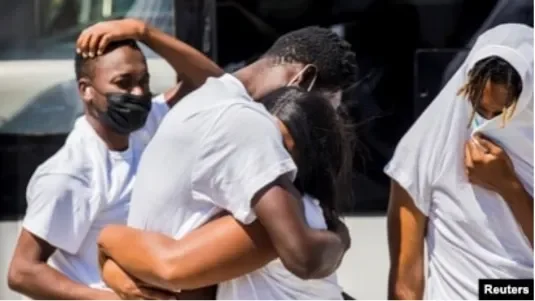
The U.S. government now advises Americans that anyone traveling to Haiti should leave behind DNA samples and dental records so their remains can be identified if the worst happens. That is the kind of warning reserved for places consumed by war or complete state collapse. Yet that same government has deployed immigration agents in our communities to track down, arrest, and deport Haitians living here under a status that was meant to protect them, sending them back to the very country it warns its own citizens could cost them their lives.
I support the work my friend Guerline Jozef is doing on behalf of Haitian families facing deportation, and I believe that fight must continue with everything we have. Every family deserves dignity, and no one should be forced back into a country where the risks of kidnapping, rape, and death are so real.
Still, as necessary as that struggle is, Temporary Protected Status (TPS) cannot be the horizon of our ambition.
That belief has put me in the crosshairs of some fellow advocates, but my work has always been guided by a broader conviction. I hold firmly that our future depends on our agency, our responsibility, and our determination to shape our own destiny.
For years, many of us have organized, marched, lobbied, and spent millions of dollars trying to shield Haitians from the consequences of Haiti’s collapse. That work has undoubtedly saved lives and should never be diminished. Yet our repeated efforts to channel even a fraction of that same energy, political capital, and money into rebuilding Haiti itself have fallen short. If we are willing to look honestly in the mirror, we will see a community capable of extraordinary mobilization in moments of crisis, yet one that has struggled to sustain the long-term effort required to build enduring institutions.
The First Deportation Began at Home
This letter is not about President Trump or his administration. It is about us and the painful realization that the crisis confronting Haitian families did not begin with the end of TTPS or with deportation orders from the Department of Homeland Security. Those are only the latest chapters in a much longer story.
Today, Haitians are being deported from the Dominican Republic, the Bahamas, and Turks and Caicos, among other countries across the hemisphere. But we must acknowledge an uncomfortable truth: the first deportation began long before various foreign governments started forcing Haitians to leave.
The TPS story began when our own political and economic elites made Haiti unlivable for millions of its people.
For decades, those who held power enforced an anti-Haitian agenda through corruption, the financing of insecurity, the protection of impunity, and the destruction of the institutions that allow a nation to function. The result was a country where millions of Haitians no longer saw a safe future for themselves or their children.
Today, every morning, parents send their children to school carrying the quiet fear that they may never return home. Young women live with the constant threat of sexual violence because armed gangs have turned rape into a weapon of terror. Families who spent generations cultivating their land have watched communities like Kenscoff burn before their eyes, leaving behind little more than ashes and grief. During just the first three months of this year, the United Nations reported more than 1,600 deaths and nearly 300 survivors of sexual violence, most of them girls between twelve and seventeen. More than 1.3 million people have been displaced within their own country, driven from their homes without ever crossing an international border.
Yet Haiti’s foreign affairs minister stood before the United Nations Security Council this week and declared that we are “closer than we’ve been in years to restoring security,” while insisting that seven of Haiti’s ten departments were ready to hold elections without major security concerns. Those words bear almost no resemblance to the Haiti that millions of Haitians know and experience.
While families struggle simply to survive, the government’s priorities do indeed tell the story of a different country. It broke ground on a new consulate in Miami in May and celebrated the construction of a VIP lounge at the Cap-Haïtien airport in July. These projects, chosen by a government that claims it lacks the resources to fight the gangs, are an affront to the many Haitians living in inhumane conditions in the encampments.
So, we must keep fighting the injustice Haitians face abroad, but we must never lose sight of the deeper injustice that made those deportations possible. Long before other governments decided Haitians no longer belonged within their borders, too many Haitian leaders abandoned their responsibility to create a country where Haitians could build lives marked by dignity, security, and hope.
We Already Have What We Need
Our dream must be bigger than preserving a temporary status that some other government can take away. Lakay se lakay. Home remains home.
I am tired of conversations that begin and end with what Washington will allow. As I wrote in Moun Andeyò, Part II, foreign interference is real and harmful, but what damages us even more is our own dependence on waiting for permission. Haiti already has what it needs. We have the intelligence, the resources, the numbers, and a culture that refuses to die. Grès kochon an ka kwit kochon an. The pig can be cooked in its own fat.
What holds us back is not a lack of capacity. It is our inability to build the institutions required to transform our collective strength into lasting power.
For generations, too many Haitians have been treated as moun andeyò, outsiders who do not belong. The term has been used to describe those beyond the centers of power, including farmers and rural communities, as well as Haitians living abroad. Yet we are the very people who feed the nation, sustain its economy, and carry its culture around the world. We are recognized for what we provide, yet intentionally excluded from the decisions about our country’s future. We, Moun andeyò, are Haiti’s largest source of human capital, yet among the most systematically excluded from being part of it. That exclusion is not accidental. A weak and divided society is easier to control and exploit.
Haiti was not born to be a cautionary tale. It was born to be a sanctuary. In 1816, under President Alexandre Pétion, Haiti’s constitution declared that any person of African descent who set foot on its soil was free. This was only a little more than a decade after our ancestors destroyed the Code Noir, the French decree that had defined Black people as property. At a time when much of the hemisphere still defended slavery, Haiti became the place where Black freedom was not a request; it was a right won at an unimaginable cost.
That is the legacy the ancestors left us. To abandon it would be our great shame.
For two centuries, Haiti has paid a heavy price for that defiance through isolation, ransom, and occupation. Today, we are physically free, yet too often remain trapped by the limitations we have placed on ourselves. The debt Haiti is owed does not erase the responsibility that this legacy places on our generation. It demands that we rise to meet it.
A Campaign for Dignity
For months, I have been writing about the need to build a movement rooted in the lived experience of moun andeyò, a Campaign for Dignity built around three foundations of Haiti’s renewal: security, prosperity, and education. These are not simply policy priorities. They are the conditions required for a nation that commits to treating its people with dignity.
Security comes first because nothing else is possible without it. Haiti’s insecurity is not simply the work of armed gangs. It is sustained by the politicians who protect them, the business interests that finance them, and a state that has abandoned its most basic responsibility to protect its citizens. For more than two decades, we have debated the failures of one international mission after another. Those debates have overshadowed the fact that no foreigner, whether Brazilians or Kenyans, can be expected to make the ultimate sacrifice for our freedom. That responsibility belongs to us.
Prosperity comes next because no nation can thrive when opportunity remains concentrated in the hands of a few. Haitians living abroad send nearly four billion dollars home every year, making us the country’s largest source of external financing. Yet too much of that wealth supports consumption and import monopolies rather than Haitian businesses, farms, and jobs. We already possess the economic capacity to strengthen our police, secure our borders, and build the intelligence institutions of a sovereign nation. What has been missing is not money. It is political will.
Our remittances can become an engine of development rather than a substitute for development. In Reimagining the Haitian Diaspora’s Role in Haiti’s Reconstruction, I proposed a Public-Private-Philanthropic Partnership, or P4, designed to transform our collective economic power into national investment by supporting Haitian producers, strengthening communities beyond Port-au-Prince, and giving Haitians living abroad a meaningful role in shaping how those resources are governed.
Education completes the foundation because no nation rises without an educated and engaged citizenry. Today, Haitians pay for education twice: through local taxes and the remittances that help keep family members in school, and through the $1.50 fee charged on every money transfer in the name of education. Yet too often, those sacrifices do not produce the schools our children deserve.
A serious national agenda must invest in teachers, classrooms, vocational training, and a curriculum rooted in Haitian history, culture, and citizenship. It must also demand accountability for every dollar collected in our name. A stronger Haiti requires not only educated Haitians, but citizens prepared to participate in building and defending their nation.
None of these ambitions will survive without institutions capable of outlasting any individual leader. We learned that lesson after the 2010 earthquake. Many of us helped build the Haitian Diaspora Federation, only to watch it collapse when democratic governance threatened the authority of a few individuals. I know that failure personally because I was part of it. The same pattern weakened the Montana Accord, as power narrowed into smaller circles until the movement lost its ability to hold itself together. I only use those two as examples, but our history is littered with similar organizations.
Our next movement cannot be built around personalities. It must be built around shared leadership and a commitment to developing the next generation of leaders. Those who sacrifice the most for Haiti, especially working-class Haitians who send money home month after month while asking for little in return, must finally have a permanent voice in shaping the country’s future.
That is why this campaign must build more than another organization. It must build an institution: a united legal, civic, and political movement capable of defending Haitians wherever they live while advancing Haiti’s long-term renewal. It must be governed by rules rather than personalities, accountable to its members rather than its founders, and broad enough to represent the taxi driver, the service worker, the street vendor, the entrepreneur, the doctor, the lawyer, the student, and the professor, the newly arrived immigrant and the naturalized citizen.
know that I have been uncompromising on these principles, and I will continue to step away from any organization or movement that cannot uphold these basic democratic values of inclusion, accountability, and shared leadership. A movement built to renew Haiti cannot repeat the same patterns of exclusion and concentration of power that have weakened our nation for generations.
The Work Begins Now
If you have read this letter to the end, I believe it says something about you. It tells me that, despite the disappointment, exhaustion, and setbacks, you are still willing to confront difficult truths because you believe Haiti is worth fighting for. Most importantly, it tells me that you may be ready to do the work that this moment requires.
The U.S. State Department has declared Haiti to be too unsafe for travel. While this is true, it is our responsibility to return Haiti to its rightful place as envisioned by our founding fathers. Jean-Jacques Dessalines asked whether the poor Black men whose fathers were in Africa would therefore have nothing. More than two centuries later, his question still hangs over us. Every generation has been called to answer it. Now it is our turn.
We have already shown the world what Haitians can accomplish.
In every country that has given us an opportunity, we have built businesses, strengthened communities, educated our children, and contributed far beyond our numbers. Yet today, many of those same countries are telling us to leave. Our answer cannot be despair. It must be the creation of something greater than survival. It must be a democratic institution that defends Haitians wherever we live while helping rebuild a homeland worthy of those who bequeathed it to us.
If this vision speaks to you, I invite you to join me in building it. Whether you are a community leader, an entrepreneur, a student, an artist, a pastor, a union organizer, or simply someone who refuses to accept that Haiti’s future has already been written, I want to hear from you.
This movement will not be built by one person. It will be built by thousands of Haitians willing to place the future of our nation above individual interests and personal ambitions.
My contact information is below. Reach out. Let us begin the conversation. Let us build the institution our generation has been waiting for.
With love, determination, and stubborn hope,
Johnny
Email: johnny.celestin@icloud.com or text me:646.543.6805
Pour lire cette lettre en français, cliquez ici:Lettre ouverte à mes compatriotes Haïtiens – Moun Andeyò